Quick answer: Wegovy vs Zepbound cost without insurance depends on the dose and program rules. For people paying cash in the United States, the official September 2026 self-pay price for a standard-dose Wegovy pen is generally $349 per 28-day fill after a limited new-patient offer. Zepbound starts at $299 for 2.5 mg, costs $399 for 5 mg, and can cost $449 for higher doses when refill conditions are met. The cheaper option depends on your prescribed maintenance dose, refill timing, device, and eligibility—not just the advertised starting price.
This comparison focuses on official manufacturer self-pay channels for the injectable products, not unpredictable retail cash prices or compounded alternatives. Prices and program rules can change. Confirm them before every fill, and do not choose or change a medicine or dose based on price alone.
The practical takeaway
- Lowest advertised starting fill: Wegovy $199 for eligible new patients versus Zepbound $299.
- Common standard ongoing self-pay price: Wegovy $349 per 28 days.
- Zepbound maintenance price: $399 at 5 mg or $449 at 7.5–15 mg when the 45-day refill condition is met.
- Budgeting trap: “Monthly” usually means 28 days, so continuous use can require 13 fills over 364 days—not 12.
Wegovy vs Zepbound cost: official self-pay prices
The table below uses the manufacturers’ U.S. self-pay pages as of September 4, 2026. A “month” means a 28-day supply. It does not include medical visits, laboratory testing, needles, syringes, taxes, or other fees.
| Product and dose | Official self-pay price | Important condition |
|---|---|---|
| Wegovy pen, 0.25 or 0.5 mg | $199 per fill for the first two fills | Limited offer for eligible new patients through December 31, 2026 |
| Wegovy pen, 0.25–2.4 mg | $349 per 28-day fill | Applies after the introductory fills and to standard-dose strengths under current terms |
| Wegovy HD pen, 7.2 mg | $399 per 28-day fill | Different formulation and price; use only if prescribed |
| Zepbound, 2.5 mg | $299 per 28-day fill | Starting dose; FDA labeling says it is not a maintenance dose |
| Zepbound, 5 mg | $399 per 28-day fill | Current official self-pay price |
| Zepbound, 7.5–15 mg | $449 per 28-day fill | Refill within 45 days to maintain the Self-Pay Journey Program price |
Novo Nordisk’s official Wegovy cost page states that new patients can pay $199 for each of the first two 0.25 mg or 0.5 mg fills through December 31, 2026, then $349 for standard pen strengths. Eli Lilly’s LillyDirect Zepbound page lists $299 for 2.5 mg, $399 for 5 mg, and $449 for higher doses under the current refill program.
Why Wegovy vs Zepbound cost is more than the starting price
The headline price usually describes one dose, one fill, and one set of eligibility rules. It does not tell you what you will spend after titration or across a full year. Before comparing Wegovy vs Zepbound cost, identify four details:
- Your prescribed product and device. Zepbound is available through different delivery formats, including a multi-dose KwikPen and single-dose vials. Supplies and handling differ.
- Your maintenance dose. Zepbound’s ongoing self-pay price is different at 5 mg than at higher doses. Wegovy also has a separately priced HD formulation.
- Your refill cadence. Both programs define a month as 28 days. Zepbound’s $449 higher-dose purchase offer also requires timely refills.
- Whether you remain eligible. Manufacturer programs may be changed or canceled, and their rules are not insurance coverage.
How Wegovy vs Zepbound cost changes over 13 fills
A 28-day supply repeated continuously creates 13 prescription cycles in 364 days. Multiplying a “monthly” price by 12 therefore understates drug spending for someone who fills every four weeks. The scenarios below are illustrations, not dosing recommendations.
| Illustrative cash-pay pattern | 12 fills (336 days) | 13 fills (364 days) |
|---|---|---|
| Wegovy standard pen: two $199 introductory fills, then $349 | $3,888 | $4,237 |
| Zepbound: one $299 fill, then remaining fills at $399 | $4,688 | $5,087 |
| Zepbound: one $299 fill, one $399 fill, then higher-dose fills at $449 | $5,188 | $5,637 |
This is the most important lesson from the price comparison: the difference between two options may be hundreds or more than a thousand dollars over a year, but only after the actual maintenance dose and refill schedule are known.
The Zepbound 45-day refill rule
For 7.5, 10, 12.5, and 15 mg Zepbound, the Self-Pay Journey Program currently offers $449 per 28-day fill. To continue at that price, Lilly says the refill purchase must be completed within 45 days of the previous delivery or receipt date. Missing the window can trigger the regular self-pay price.
| Zepbound dose | Program price | Regular price if higher-dose offer does not apply |
|---|---|---|
| 7.5 mg | $449 | $499 |
| 10 mg | $449 | $699 |
| 12.5 mg | $449 | $699 |
| 15 mg | $449 | $699 |
Set a refill reminder based on the delivery or pickup date, not merely the date the prescription was written. If treatment is intentionally paused for a medical reason, contact the program before assuming the same price will resume automatically.
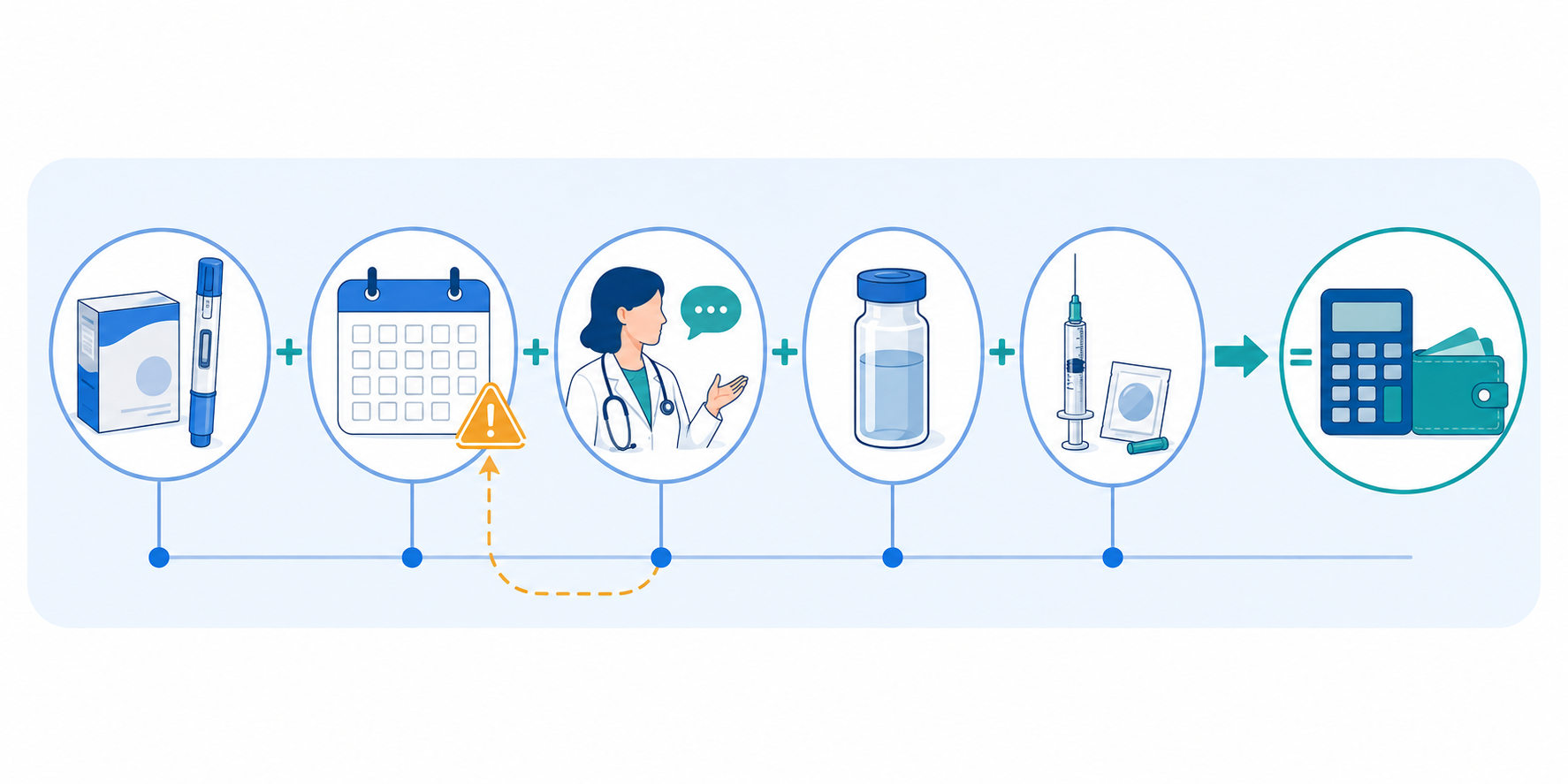
What Wegovy vs Zepbound cost may not include
- Initial and follow-up visits: Ask whether a telehealth membership or recurring clinician fee is required.
- Laboratory tests: The clinician may order testing based on your history, symptoms, and other medications. Ask which tests are required and what they cost before collection.
- Injection supplies: Lilly notes that Zepbound KwikPen users need pen needles, while vial users need a new needle and syringe. These may be purchased separately.
- Shipping or pickup fees: Official channels currently advertise free delivery or designated pickup options, but verify your location and checkout total.
- Taxes and fees: Program materials state that additional taxes or fees may apply.
- Care for side effects or complications: Medical evaluation and treatment are separate from the drug price.
Paying the Wegovy vs Zepbound cost: cash or insurance
Self-pay can be simpler when a plan excludes anti-obesity medication or requires a long authorization process. However, paying outside insurance may not count toward your deductible or annual out-of-pocket limit. NovoCare explicitly warns about this on its Wegovy pricing page.
Before choosing cash pay, compare it with the full insurance pathway. Our guide, Does Insurance Cover Weight Loss Medication in 2026?, explains formularies, prior authorization, Medicare, Medicaid, and appeals. If insurance covers the medicine, a commercial-insurance savings card may reduce the copay—but eligibility and maximum-savings rules apply.
A five-question script before you pay
“Please confirm the exact product, dose, device, and quantity. Is this a 28-day supply? What will I pay today, and what will the next three fills cost if my dose changes? Are clinician visits, labs, needles, syringes, shipping, taxes, or membership fees separate? What deadline must I meet to keep the program price?”
Request the answers in writing or save a screenshot of the checkout terms. Manufacturer prices can change faster than an article can be updated.
Do not treat compounded GLP-1 products as identical substitutes
Some advertisements compare a low compounded-product price with a branded medicine’s list price. That is not an apples-to-apples comparison. The FDA states that compounded drugs are not reviewed for safety, effectiveness, or quality before marketing in the same way as FDA-approved products. The agency has also reported dosing errors and concerns about products marketed as alternatives to approved semaglutide or tirzepatide.
Read the FDA’s current GLP-1 safety guidance. If an approved product cannot meet a specific medical need, discuss legally appropriate compounding with a licensed clinician and state-licensed pharmacy; do not make the decision from price alone.
Frequently asked questions
Which is cheaper without insurance: Wegovy or Zepbound?
Under current official self-pay programs, standard-dose Wegovy is usually cheaper after the introductory period at $349 per 28 days. Zepbound is $399 at 5 mg and $449 at higher doses when program refill conditions are met. The medically appropriate treatment and dose must be decided separately.
Is the $199 Wegovy price permanent?
No. As of September 4, 2026, it is a limited introductory price for the first two eligible new-patient fills of 0.25 mg or 0.5 mg, available through December 31, 2026. Current terms then price standard pen strengths at $349 per fill.
Why can a year require 13 “monthly” payments?
Because the programs define one month as 28 days. Thirteen 28-day supplies cover 364 days. Actual spending depends on your fill dates and whether treatment continues without interruption.
Does self-pay require prior authorization?
The Zepbound self-pay program states that prior authorization is not required, but a valid prescription for an approved use and other conditions apply. This is different from submitting the medication through an insurance plan.
Does cash spending count toward my insurance deductible?
Often it does not when the purchase is processed outside insurance. Confirm with your plan before paying. Keep receipts in case your plan has a reimbursement or manual-claim process, but do not assume reimbursement will be approved.
Bottom line
The most useful Wegovy vs Zepbound cost comparison is based on the next 13 fills, not the first advertised price. Write down the prescribed dose, device, 28-day price, refill deadline, likely maintenance price, and every separate clinical or supply fee. Then compare the full cash-pay budget with your insurance option before committing.
Sources and further reading
- Wegovy: official cost and coverage information
- NovoCare: Wegovy self-pay and insurance options
- LillyDirect: Zepbound devices and self-pay prices
- Eli Lilly: Zepbound Self-Pay Journey Program terms
- FDA: Zepbound prescribing information
- FDA: concerns with unapproved GLP-1 drugs
Written and edited by: Denny Jaeyong Choi (JD), INSEAD MBA
Last updated: September 7, 2026
Medical information notice: This article provides general educational information and does not replace individualized medical advice, diagnosis, or treatment. Prices, eligibility rules, and programs can change. Verify current terms with the manufacturer, pharmacy, insurer, and prescribing clinician.