Quick answer: Metabolic syndrome blood tests are not a single special panel. It combines waist circumference and blood pressure with three laboratory measurements: fasting glucose, triglycerides, and HDL cholesterol. U.S. insurance may cover some of these as preventive screening when you meet plan criteria and use in-network care. The same tests may be subject to a deductible, copay, or coinsurance when they are ordered to evaluate symptoms or monitor a known condition. Confirm the reason for the order, the laboratory network, and your estimated cost before the blood draw.
Published: September 13, 2026 · Last reviewed: September 13, 2026
Written and edited by: Denny Jaeyong Choi (JD), INSEAD MBA
Key takeaways
- Metabolic syndrome is generally identified when at least three of five risk factors are present. Only three of those five require a blood sample.
- A fasting glucose test is not the same as an A1C. Fasting glucose usually requires at least eight hours without food; an A1C usually does not.
- “Preventive” does not automatically mean every related lab is free. Network status, age and risk criteria, the diagnosis attached to the order, and services performed during the same visit can affect cost-sharing.
- Original Medicare Part B covers eligible diabetes screening up to twice per year and a cardiovascular lipid screening once every five years, with no charge when coverage rules are met and the provider accepts assignment.
- The best cost-control step is to ask for the exact test names, the laboratory, and a pre-service estimate before your appointment.
What are metabolic syndrome blood tests?
Metabolic syndrome is a cluster of findings that together raise the risk of cardiovascular disease, type 2 diabetes, stroke, and other health problems. The National Heart, Lung, and Blood Institute (NHLBI) says a clinician may diagnose it when three or more of five conditions are present. Those conditions are a large waistline, elevated blood pressure, elevated fasting glucose, elevated triglycerides, and low HDL cholesterol. Our separate guide explains the five metabolic syndrome criteria in more detail.
The phrase “metabolic syndrome blood panel” can therefore be misleading. There is no single universal panel with that name. A clinician usually combines a physical assessment with a glucose test and a lipid panel. The exact order may vary based on your history, medications, symptoms, prior results, and what your insurance plan covers.
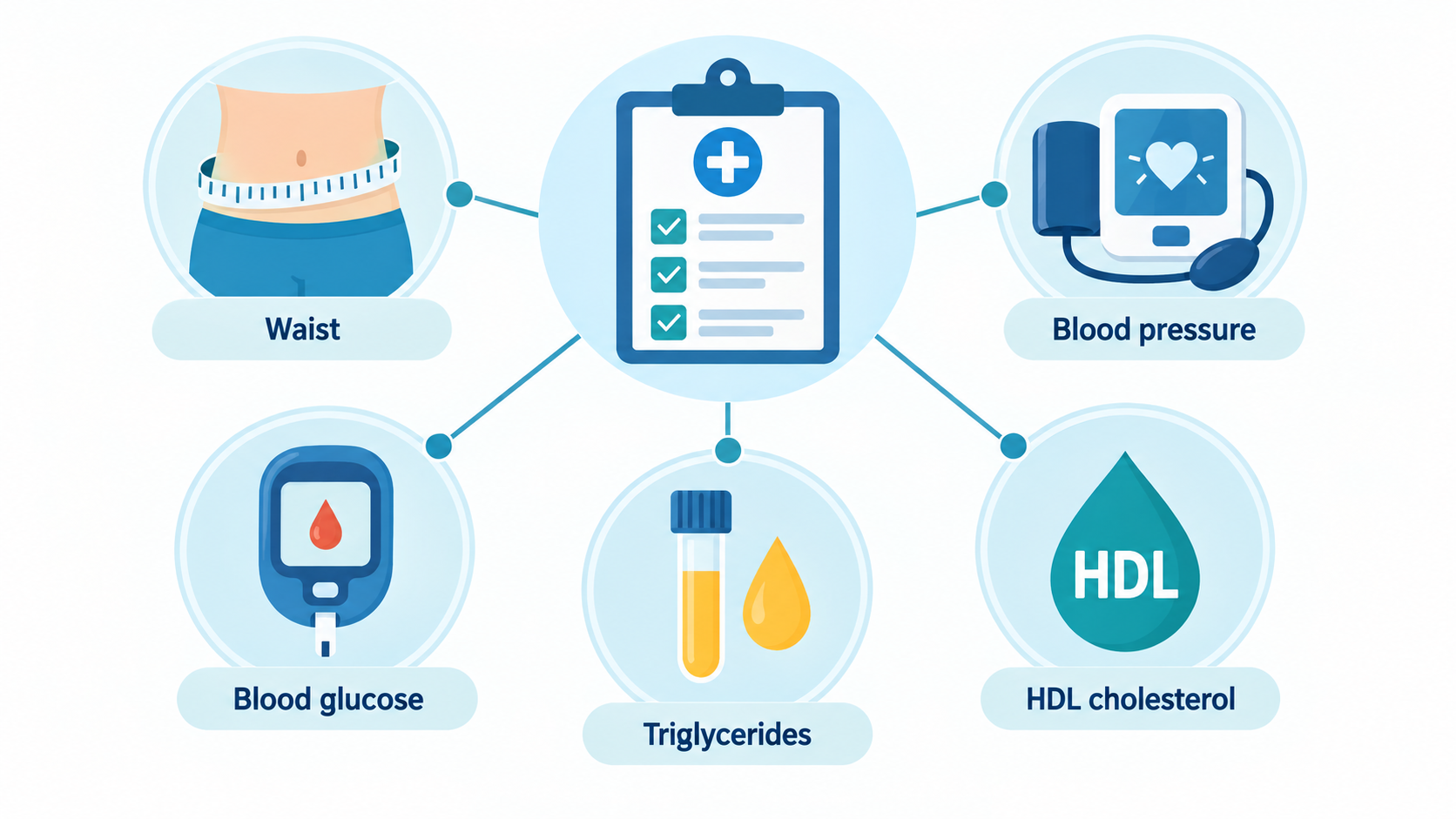
The five measurements, in plain English
| Measurement | Common threshold used for metabolic syndrome | Does it require fasting? | Typical insurance question |
|---|---|---|---|
| Waist circumference | More than 40 in (102 cm) for men or 35 in (88 cm) for women; ethnicity-specific cutoffs may differ | No | Usually part of an office assessment rather than a separate lab claim |
| Blood pressure | 130/85 mm Hg or higher, or treatment for high blood pressure | No | Screening may be preventive; evaluation or management can generate a visit charge |
| Fasting glucose | 100 mg/dL or higher, or treatment for elevated glucose | Yes, when specifically ordered as fasting plasma glucose | Ask whether the order is preventive diabetes screening or diagnostic testing |
| Triglycerides | 150 mg/dL or higher, or treatment for elevated triglycerides | Follow the ordering clinician’s instructions | Often included in a lipid panel; preventive frequency limits may apply |
| HDL cholesterol | Below 40 mg/dL for men or below 50 mg/dL for women, or treatment | Follow the ordering clinician’s instructions | Usually included in a lipid panel rather than billed alone |
The NHLBI diagnostic guide describes these measurements and notes that waist cutoffs may vary by race and ethnicity. One result also does not diagnose diabetes by itself in an asymptomatic person. The National Institute of Diabetes and Digestive and Kidney Diseases (NIDDK) explains that abnormal diabetes testing is usually confirmed with a second measurement.
Which metabolic syndrome blood tests should you ask about?
1. Fasting plasma glucose
This is the glucose measurement used in the classic metabolic syndrome criteria. NIDDK says it is usually performed in the morning after at least eight hours of fasting, with only sips of water. A result from a home glucose meter cannot diagnose diabetes.
2. A lipid panel
A standard lipid panel commonly reports triglycerides and HDL cholesterol, as well as total and LDL cholesterol. Triglycerides and HDL are the two components used for metabolic syndrome. LDL is important for cardiovascular risk management, but it is not one of the five metabolic syndrome criteria.
3. A1C, when clinically appropriate
An A1C estimates average blood glucose over roughly three months and usually does not require fasting. It can screen for prediabetes or diabetes, but it does not directly replace fasting glucose in every definition of metabolic syndrome. It can also be less reliable in some situations, including certain anemias, hemoglobin variants, recent blood loss, kidney failure, or pregnancy. Your clinician should decide whether fasting glucose, A1C, or another test best answers the clinical question.
A continuous glucose monitor is not normally required to diagnose metabolic syndrome. If you are comparing self-pay options for glucose tracking, see our guide to CGM cost without insurance.
Will insurance cover metabolic syndrome blood tests?
Often, at least part of the evaluation is covered—but “covered” and “free” are not the same. HealthCare.gov says Marketplace plans and many other plans cover specified preventive services without copayment or coinsurance, generally when the service is delivered by an in-network provider. Its adult list includes blood pressure screening, cholesterol screening for eligible adults, type 2 diabetes screening for certain adults with overweight or obesity, and obesity screening and counseling. The page also warns that zero-dollar coverage is not guaranteed in every case.
The U.S. Preventive Services Task Force currently recommends screening asymptomatic adults ages 35 to 70 who have overweight or obesity for prediabetes and type 2 diabetes. Yet your plan document, network rules, and the way the claim is coded still matter. A plan may treat a test differently if you already have diabetes, high cholesterol, hypertension, symptoms, an abnormal prior result, or a medication that needs monitoring.
Preventive screening versus diagnostic testing
This distinction causes many surprise bills:
- Preventive screening looks for disease in someone without symptoms who meets guideline and plan criteria.
- Diagnostic testing evaluates a symptom, abnormal result, suspected condition, or known disease.
- Monitoring follows an already diagnosed condition or treatment.
The same laboratory test can fall into any of these categories. The difference may affect deductible and coinsurance. The ordering clinician—not the patient—selects the diagnosis and reason for the order, and the insurer adjudicates the claim. You should not ask anyone to change accurate coding simply to avoid a charge. Instead, ask for an estimate based on the clinically correct order.
What does Medicare cover for metabolic syndrome blood tests?
Original Medicare handles the glucose and lipid portions under separate benefits:
- Diabetes screening: Medicare Part B covers eligible glucose screenings when a clinician determines that you are at risk. Medicare lists high blood pressure, abnormal cholesterol or triglycerides, obesity, and a history of high blood sugar among qualifying risk factors. Covered tests may include fasting or nonfasting glucose, A1C, or another Medicare-approved glucose test. Medicare.gov states that eligible beneficiaries can receive up to two screenings per year and pay nothing when the provider accepts assignment.
- Cardiovascular screening: Part B covers blood tests for cholesterol, lipid, and triglyceride levels once every five years. Medicare.gov says you pay nothing when the provider accepts assignment.
- Annual Wellness Visit: the visit includes blood pressure, weight, BMI or waist measurement when appropriate, and a personalized prevention plan. However, the visit itself does not automatically bundle every laboratory test. Labs must qualify under their own coverage rules, as the CMS guidance makes clear.
Medicare Advantage plans must cover Medicare-covered services but can use plan networks and administrative rules. Call the number on your plan card for the lab network and expected cost. If an abnormal glucose result identifies prediabetes, some beneficiaries may also qualify for the Medicare Diabetes Prevention Program.
A five-minute call that can prevent a surprise bill
Call your insurer before the blood draw. Use the exact test names on the order and ask:
- Is the ordering clinician in network?
- Is the laboratory in network? Hospital-owned labs and independent labs may have different rates.
- Are fasting plasma glucose, A1C, and the lipid panel covered as preventive screening for me?
- Do age, risk-factor, or frequency rules apply?
- Will I owe a deductible, copay, or coinsurance if the order is diagnostic or for monitoring?
- Do I need a referral or prior authorization?
- Can you give me a call reference number or written estimate?
You can also ask the clinic: “Which tests are being ordered, which lab will process them, and can you send me the order so I can request a plan estimate?” If you are paying cash, request the self-pay price in writing and compare it with your expected in-network cost. A low cash price may not count toward your deductible.
How to prepare for metabolic syndrome blood tests
- Confirm whether fasting is required. If fasting plasma glucose is ordered, NIDDK advises at least eight hours without food; follow the lab’s exact instructions.
- Ask about medications. Do not stop prescribed medicine on your own. Ask whether to take morning medicines and supplements before testing.
- Bring prior results. Trends can be more informative than one isolated value.
- Wear practical clothing. A correct waist measurement is taken around the abdomen, not over a bulky jacket.
- Rest before blood pressure measurement. Tell the clinician about caffeine, exercise, smoking, pain, or stress that may affect the reading.
A complete assessment should not reduce you to a single number. Our complete obesity evaluation guide explains how history, body measurements, complications, sleep, medications, barriers, and personal goals fit together.
What if metabolic syndrome blood tests are abnormal?
One abnormal value is a reason for a clinical conversation, not a self-diagnosis. Your clinician may repeat a measurement, confirm that the test was performed correctly, assess medications and other causes, or order additional tests. Metabolic syndrome is a risk framework; each component also deserves individual management.
If three or more criteria are present, the next step is usually to address overall cardiovascular and diabetes risk rather than chase a label. That can include nutrition, physical activity, sleep, tobacco cessation, weight management, and treatment of blood pressure, glucose, or lipids when appropriate. If cost or coverage blocks care, tell the clinic. A feasible plan may use an in-network lab, covered preventive services, staged testing, or a different follow-up schedule.
Frequently asked questions
Is there one blood test for metabolic syndrome?
No. Assessment combines waist circumference, blood pressure, fasting glucose, triglycerides, and HDL cholesterol. The last three involve laboratory testing.
Do I need to fast?
You need to fast for a fasting plasma glucose test. An A1C does not usually require fasting. Lipid-testing instructions can vary, so follow the order and laboratory directions rather than guessing.
Will an annual physical include these labs for free?
Not necessarily. Your plan may cover specific preventive screenings, but the office visit and each laboratory service have separate coverage rules. Original Medicare’s Annual Wellness Visit is not the same as a routine physical and does not automatically include clinical laboratory tests.
Can I use home readings?
Home blood pressure logs can provide useful context, but diagnosis should be confirmed with a clinician using a validated device and proper technique. A consumer glucose meter or CGM cannot by itself diagnose diabetes or metabolic syndrome.
Bottom line
Metabolic syndrome blood tests are only part of the workup: clinicians also measure waist and blood pressure, then check fasting glucose, triglycerides, and HDL. The billing can be less simple. Ask whether each service is preventive or diagnostic, verify both clinician and lab networks, and request an estimate. That preparation is often more useful than searching for a generic “metabolic panel,” which may not contain the tests needed to evaluate metabolic syndrome.
Sources and further reading
- NHLBI: Metabolic Syndrome Diagnosis
- NHLBI: What Is Metabolic Syndrome?
- NIDDK: Diabetes Tests & Diagnosis
- USPSTF: Screening for Prediabetes and Type 2 Diabetes
- HealthCare.gov: Preventive Care Benefits for Adults
- Medicare.gov: Diabetes Screenings
- Medicare.gov: Cardiovascular Disease Screenings
- CMS: Annual Wellness Visit
Medical and insurance information notice: This article provides general educational information and does not replace individualized medical advice, diagnosis, treatment, or a coverage determination from your insurer. Benefits, networks, billing rules, and clinical recommendations can change. Confirm current details with your clinician, laboratory, and health plan.