If your GLP-1 prior authorization was denied, the next step is not always “write an appeal.” First identify whether the problem is missing information, a formulary rule, step therapy, medical-necessity criteria, a benefit exclusion, or the wrong coverage pathway.
Written and edited by Denny Jaeyong Choi (JD), INSEAD MBA
Published September 12, 2026 · Last updated September 12, 2026
GLP-1 prior authorization denial: quick answer
If you received a GLP-1 prior-authorization denial, get the written denial and its exact reason before doing anything else. A missing chart note may be fixed by resubmission, while a medical-necessity denial may need an internal appeal supported by your prescriber. A nonformulary drug may require a formulary exception. A plan-wide exclusion may be much harder to overturn because medical evidence does not automatically create a benefit the plan excludes.
Deadlines depend on the plan. HealthCare.gov says many commercial-plan internal appeals must be filed within 180 days of the denial notice, while a federal external-review request generally must be filed within four months of the final denial. Employer plans, Medicare Part D, Medicaid, and the temporary Medicare GLP-1 Bridge follow different procedures. Start with the instructions printed on your own denial notice.
GLP-1 prior authorization appeal: key takeaways
- Ask for the denial in writing. Record the date, denial code, policy cited, deadline, and appeal address or portal.
- Separate a fixable submission problem from a coverage decision. A missing form is different from a benefit exclusion.
- Build the appeal around the plan’s actual criteria. More pages do not make a stronger appeal if they do not answer the stated reason.
- Keep the product and indication precise. Plans evaluate the exact brand, formulation, dose, diagnosis, and requested use.
- Use the correct system. Commercial plans, self-funded employer plans, Medicare Part D, Medicaid, and the Medicare GLP-1 Bridge do not share one appeal process.
- Request expedited review only when medically appropriate. The treating clinician should explain why the standard timeline could seriously jeopardize health or the ability to regain maximum function.
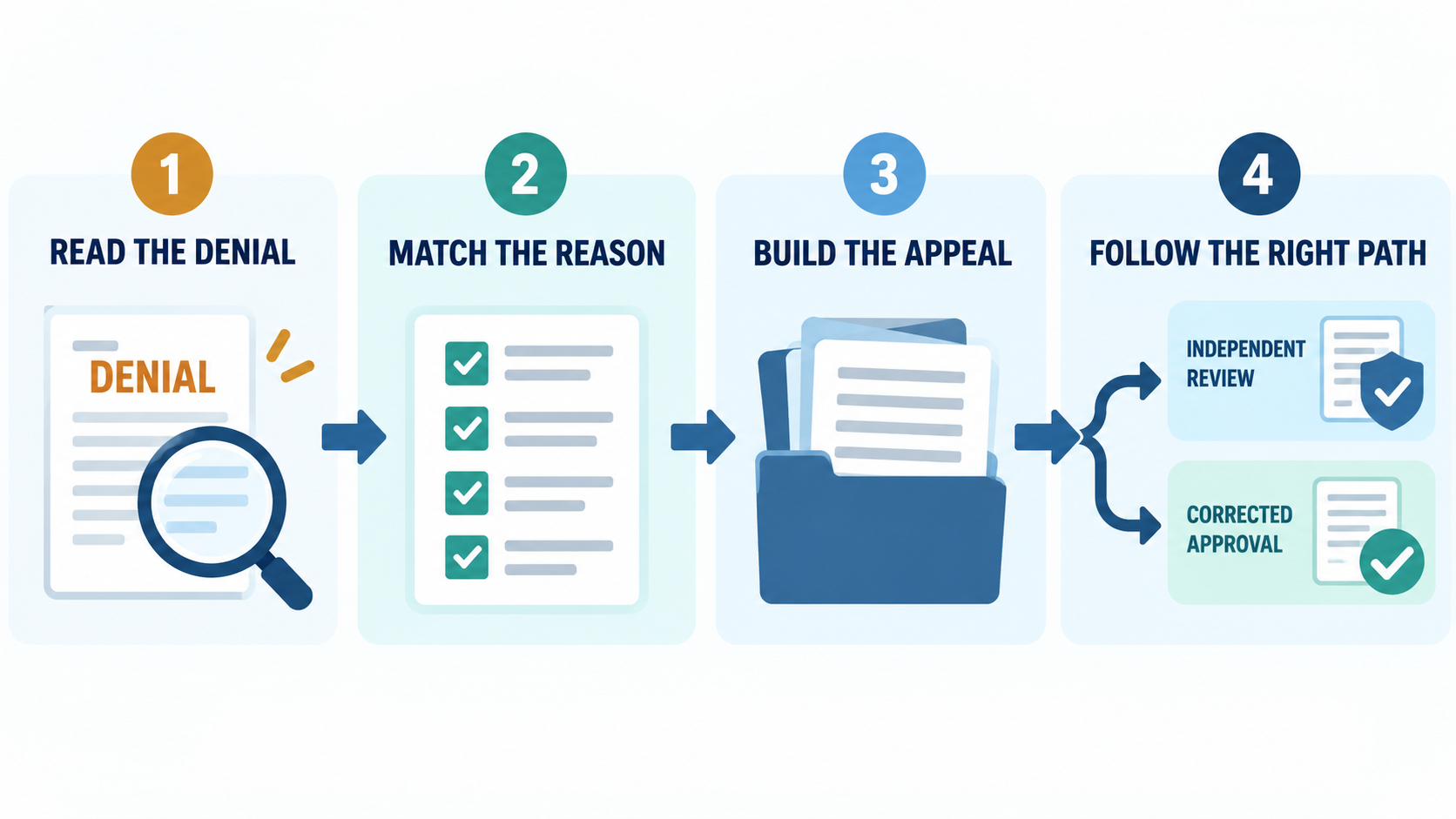
GLP-1 prior authorization: read the denial first
A pharmacy message such as “PA required,” “not covered,” or “refill too soon” is useful, but it may not be the plan’s final written decision. Ask the pharmacy for the rejection message and ask the plan or pharmacy-benefit manager for the formal notice. The notice should identify what was denied, why, what evidence was considered, and how to challenge the decision.
For many private plans, HealthCare.gov’s internal-appeal guidance says the insurer must explain a denial in writing. For job-based plans governed by ERISA, the U.S. Department of Labor says participants can request relevant claim documents and records without charge. These documents help you see whether the decision turned on the benefit design, the formulary, a clinical rule, or incomplete information.
Write down these eight facts
- Exact drug name, formulation, strength, and quantity
- Diagnosis or indication submitted by the prescriber
- Date the request and denial were issued
- Denial code and reason quoted word for word
- Policy, formulary, or prior-authorization criteria cited
- Internal-appeal deadline and submission method
- Whether an expedited review is available
- Reference numbers and the names and dates of phone conversations
GLP-1 prior authorization: match the denial reason
A benefit exclusion deserves special caution. A prescriber’s statement that a drug is medically necessary can be important, but it does not automatically override a contract that excludes a benefit. The useful question is whether the exclusion was applied correctly to the exact indication. For example, the same drug family may be evaluated differently when used for weight management versus an FDA-approved condition that the plan covers. Our 2026 weight-loss medication coverage guide explains how benefit exclusions, formularies, indications, and utilization rules differ.
GLP-1 prior authorization: choose the right appeal pathway
Commercial or Marketplace plan
HealthCare.gov describes two levels: an internal appeal to the insurer and, for qualifying denials, an independent external review. Its current guidance says an internal appeal generally must be filed within 180 days after the denial notice. A standard internal decision is generally due within 30 days for care not yet received and 60 days for services already received. Read the plan notice because the precise process and any additional levels can vary.
If the final internal decision still denies a matter involving medical judgment, an external review may be available. HealthCare.gov’s external-review page says the request generally must be filed within four months; standard reviews are decided no later than 45 days and expedited reviews no later than 72 hours. The final denial should tell you whether the state or the federal process applies.
Self-funded employer plan
Many employer plans are self-funded and governed by federal ERISA rules even when an insurance company administers the claims. Read the Summary Plan Description and denial notice. The Department of Labor’s benefits-claim guide says a participant has at least 180 days to appeal and can request documents relevant to the claim. The notice should explain the plan’s external-review rights when applicable. The Employee Benefits Security Administration can answer questions about ERISA rights, but it does not replace the plan’s filing deadline.
Medicare Part D
For a drug that may be covered under ordinary Part D, begin with a coverage determination or formulary exception. CMS says an enrollee, prescriber, or representative may request a standard or expedited determination. A standard request for benefits is generally decided within 72 hours and an expedited request within 24 hours; for an exception, the clock begins when the plan receives the prescriber’s supporting statement.
If the Part D determination is unfavorable, CMS calls the first appeal a redetermination. The current CMS redetermination guidance gives 65 calendar days from the notice date to file. The plan generally has seven calendar days for a standard redetermination and 72 hours for an expedited one. Later levels can involve an Independent Review Entity, so follow the instructions in each decision.
Medicare GLP-1 Bridge
The temporary Medicare GLP-1 Bridge is different from ordinary Part D. CMS states that the Bridge has no formal appeal process. If the prior authorization contained incorrect, incomplete, updated, or additional information, the prescriber may submit it again. The pharmacy claim must establish Bridge eligibility before the prescriber sends the authorization; submitting in the wrong order can produce a “patient not found” error. See the CMS provider FAQ and our Medicare GLP-1 Bridge guide.
Medicaid
Medicaid drug coverage and prior-authorization rules are state-specific. Use the deadline and appeal or fair-hearing instructions in the state notice. CMS explains that states must provide an opportunity for a fair hearing when benefits or services are denied, reduced, suspended, or terminated, but filing methods and timelines vary. See the CMS Medicaid fair-hearing factsheet and your state Medicaid agency’s current rules.
Step 4: build a focused GLP-1 prior authorization appeal packet
A strong packet answers the denial rather than retelling the entire medical history. Ask the prescribing office which parts it will submit and which parts you must submit. Keep copies of everything.
- The written denial or Explanation of Benefits
- The current formulary entry, prior-authorization criteria, or policy cited
- The original authorization request and proof of submission
- A concise prescriber letter addressing each disputed criterion
- Relevant chart notes, diagnosis information, measurements, laboratory results, or treatment history
- Accurate records of covered alternatives tried, contraindicated, ineffective, or poorly tolerated
- The exact requested product, formulation, strength, quantity, and intended indication
- An authorized-representative form if the clinician or another person will file for you
- A dated index listing every attachment
Do not add unrelated records “just in case.” Extra pages can obscure the one missing fact. If weight history or complications are central to the policy, our complete obesity evaluation guide can help you understand the kinds of clinical context a careful evaluation may document. It is not a checklist for gaming coverage criteria.
A practical GLP-1 appeal letter template
Subject: Request for internal appeal of GLP-1 coverage denial
Member: [name]
Member ID: [ID]
Request or claim number: [number]
Drug: [exact brand, formulation, strength, and quantity]
Denial date: [date]
I am requesting a full review of the denial identified above. The denial notice states: “[quote the reason exactly].”
The enclosed information addresses that reason as follows:
- [Plan criterion or disputed fact]
- [Accurate supporting information and attachment]
- [Why the requested exception applies, if relevant]
Please reconsider the request and provide the decision in writing. If additional information is required, please identify the missing item and the deadline. Please also provide the policy, clinical criteria, and claim records relied on for the decision if they have not already been supplied.
Attachments: [numbered list]
Adapt the letter to the plan. Medicare uses its own determination and appeal terminology; Medicaid notices may require a state form; a missing-information denial may be faster to correct and resubmit than to package as a formal appeal.
When should a GLP-1 prior authorization appeal be expedited?
Do not label a case urgent simply to move it faster. Ask the treating clinician whether waiting through the standard process could seriously jeopardize life, health, or the ability to attain, maintain, or regain maximum function. When that standard is met, the clinician should state the reason clearly and use the plan’s expedited process.
HealthCare.gov says a person in an urgent situation may request an external review while the internal appeal is still pending. Medicare Part D also permits expedited coverage determinations and redeterminations when the regulatory standard is met. If symptoms themselves require urgent medical attention, contact appropriate medical services; an insurance appeal is not emergency care.
What to do after you submit a GLP-1 prior authorization appeal
- Confirm receipt. Ask for the date, time, reference number, and number of pages received.
- Check whether the packet is complete. Confirm that the prescriber’s statement and attachments are visible in the file.
- Calendar the decision deadline. Use the plan’s written timeframe, not an estimate from a general article.
- Request the decision in writing. A phone approval is helpful, but the written outcome controls the next step.
- If denied again, read the new reason. The next notice should explain external review, further Medicare levels, a fair hearing, or other rights.
- Keep cash payment separate. Paying out of pocket does not guarantee later reimbursement or deductible credit. Our 2026 self-pay comparison explains current manufacturer channels, and our HSA and FSA guide explains when unreimbursed expenses may qualify.
Frequently asked questions
Does a GLP-1 prior-authorization denial mean the drug can never be covered?
No. Some denials are caused by missing information or an unmet administrative step and can be corrected. Others involve medical-necessity criteria or a formulary exception that can be appealed. A categorical benefit exclusion may be harder to change. The written reason tells you which situation you have.
Should I appeal or ask the office to resubmit?
If the notice identifies missing or incorrect information, a corrected resubmission may be the direct response. If the plan has made an adverse coverage decision after reviewing a complete request, follow the formal appeal instructions. Ask the plan to state which process it expects.
Can my doctor appeal for me?
Often yes, but the plan may require an authorized-representative form. The prescriber may also be needed for the clinical statement or an expedited request. Confirm responsibilities so the same appeal is not lost between the patient, clinic, pharmacy, and plan.
Will a letter of medical necessity guarantee approval?
No. A focused letter can address medical-necessity or exception criteria, but it cannot guarantee coverage and may not overcome a plan-wide exclusion. The letter should use accurate clinical facts and respond to the policy cited in the denial.
Can I appeal a step-therapy requirement?
Many plans provide an exception process. The prescriber should explain, when accurate, which required alternatives were tried and what happened, or why a covered alternative is contraindicated or expected to be less effective. Requirements vary by plan and state.
What if the Medicare GLP-1 Bridge denies the request?
CMS says the Bridge itself has no formal appeal process. The prescriber can resubmit when the original request contained incorrect information or when updated or additional information is available. Do not confuse this with ordinary Part D appeal rights for a Part D-coverable indication.
Does an external reviewer have to follow the plan’s decision?
An external reviewer independently evaluates qualifying denials. HealthCare.gov states that when the reviewer overturns the insurer’s decision, the insurer must accept that outcome. Eligibility for external review depends on the denial and the plan, so use the instructions in the final internal denial.
Bottom line: your GLP-1 prior authorization appeal
When a GLP-1 prior authorization is denied, speed comes from precision. Get the written reason, identify the plan type, match the response to the exact denial, and submit only the evidence that answers it. A correction, formulary exception, internal appeal, external review, Medicare redetermination, Medicaid fair hearing, and Medicare GLP-1 Bridge resubmission are not interchangeable.
Sources and further reading
- HealthCare.gov: Internal appeals
- HealthCare.gov: External review
- U.S. Department of Labor: Filing a claim for health benefits
- CMS: Medicare Part D coverage determinations
- CMS: Medicare Part D redetermination
- CMS: Medicare GLP-1 Bridge information for providers
- CMS: Understanding Medicaid fair hearings
Written and edited by: Denny Jaeyong Choi (JD), INSEAD MBA
This article was prepared with AI-assisted research and drafting and checked against the cited U.S. government sources on September 12, 2026. It provides general educational information, not individualized medical, legal, tax, or insurance advice. Coverage policies, formularies, deadlines, and government programs can change. Verify the current notice, plan documents, and official instructions before acting.