Tag: Medicare

  • Medicare Open Enrollment 2027: A Checklist for Diabetes and GLP-1 Care

    A practical way to compare prescription coverage, pharmacies, and care access—without mistaking a low premium for a low yearly bill.

    Published: October 1, 2026 · Last updated: October 1, 2026

    Quick answer

    Medicare open enrollment 2027 is the fall 2026 opportunity to choose coverage for next year. The enrollment window runs October 15–December 7, 2026, with changes taking effect January 1, 2027. Start by reviewing your current plan’s changes, then compare your exact medicines and pharmacies—not just the monthly premium. Medicare’s enrollment dates and options.

    If you take a GLP-1, establish whether your prescription goes through ordinary Part D coverage or the separate Medicare GLP-1 Bridge. Those are different payment routes. A promising price in a search result does not confirm that your prescription qualifies. CMS Bridge guidance.

    The essentials before you compare

    • Use the 2027 plan documents, even if the plan name looks unchanged.
    • Compare yearly prescription costs and monthly cash flow separately.
    • Check the exact medicine, strength, formulation, and quantity.
    • Resolve coverage restrictions before treating an estimate as dependable.
    • Keep a written record of the plan, pharmacy, documents, and answers you used.

    This is a coverage-planning guide, not a recommendation to switch plans or change treatment. Its purpose is to help you ask more precise questions before a decision.

    Why review your plan now?

    On September 28, CMS released its 2027 Medicare Advantage and prescription-drug market update. It projected relatively stable average standalone Part D premiums and highlighted new comparison features arriving in October. National averages, however, are not a quote for your ZIP code or medication list. Read the CMS 2027 announcement.

    Think of the comparison as checking a route before a long trip. The sign may look familiar while a turn has changed. A useful review asks: can I still obtain my prescribed treatment, from a workable pharmacy, with a budget I understand?

    Your plan’s Annual Notice of Change (ANOC) should arrive in September. It outlines changes taking effect in January. If you did not receive it, request it from your plan. Medicare’s explanation of the ANOC.

    Step 1: Make a medication list that a computer can actually price

    “Diabetes injection” is not specific enough. Before opening a comparison tool, put your prescription labels beside you. For each medicine, record:

    • The full name and whether the prescription specifies a brand.
    • The strength and formulation, such as a tablet, vial, or particular pen.
    • The prescribed quantity and refill interval.
    • The pharmacy you actually use, plus a realistic alternative.
    • Any current approval letter and its expiration date.

    Then check the list against your clinician’s current medication record. Do not include an old prescription you no longer take merely because it remains in a saved account. Equally, do not omit an expensive medicine because you fill it only occasionally.

    Medicare’s comparison tools can use your prescriptions to estimate monthly and yearly costs. The quality of that estimate depends on the information you enter. If a medicine or quantity cannot be entered correctly, write down the mismatch and ask the plan to resolve it.

    Step 2: Separate a formulary listing from permission to fill

    A formulary is a plan’s covered-drug list. Finding a drug there is important, but it is not the final coverage check.

    Plans may require prior authorization, step therapy, or quantity limits. In plain language, these can mean approval before payment, trying a specified alternative first, or a limit on the amount covered. Some drugs are covered only for particular medical conditions. Medicare’s drug-plan rules.

    For each important medicine, ask: “What must my prescriber submit for this exact prescription in 2027?” Also ask whether an existing approval remains valid after the plan or year changes. Do not assume either answer.

    If the answer is unclear, ask for the relevant coverage document or a written explanation. A customer-service conversation is useful preparation, but it does not replace a required coverage decision. For a current rejection, our GLP-1 denial and appeal guide explains how to organize the next questions.

    Step 3: Use a Medicare open enrollment 2027 comparison sheet

    Copy the following checklist into a note. Add one column for your current plan’s 2027 version and another for each alternative. Leave unresolved items marked “not confirmed” rather than treating a blank as a yes.

    A practical worksheet—not a coverage guarantee
    CheckWhat to recordQuestion to resolve
    Plan identityYear, full plan name, plan ID, service areaAm I reading the correct version?
    Prescription accessExact drug and formulation; restrictionsIs approval needed for my prescribed use?
    PharmacyLocation, network status, estimated costCan I reliably use this pharmacy?
    Annual budgetPremiums and estimated drug spendingWhat is included or missing?
    Early-year costsJanuary and February estimatesCan I manage the timing of payments?
    Care continuityClinicians, suppliers, current authorizationsWhat needs confirmation before switching?

    On a phone, swipe the table horizontally. This worksheet is our editorial planning aid; the plan’s documents and coverage decisions govern benefits.

    Step 4: Compare the annual bill, not just the premium

    Medicare lists a maximum Part D deductible of $700 for 2027 and a $2,400 annual out-of-pocket limit for covered Part D drugs. Some plans have a lower deductible or none. These figures are not a cap on all health spending, and a drug must be covered for the Part D protection to apply. Premiums are a separate expense. Medicare’s current drug-cost guidance.

    Consider this fictional arithmetic example, not a real plan quote. Plan A has a $10 monthly premium and $900 in estimated annual prescription spending: $1,020 together. Plan B has a $40 premium and $300 in prescription spending: $780 together. The higher-premium option is $240 cheaper on those two inputs.

    That does not make Plan B universally better. First verify that both estimates use the same drugs, quantities, and pharmacy assumptions. Also check what the displayed total already includes so you do not add a deductible twice. Keep medical expenses, uncovered items, and any separate program costs visible rather than hiding them inside one optimistic total.

    Step 5: Price a pharmacy you can realistically use

    Being in network and having preferred cost sharing are not always the same thing. Medicare explains that preferred in-network pharmacies may offer lower out-of-pocket prices than other network pharmacies. Out-of-network fills will often cost more. Medicare’s pharmacy guidance.

    Compare your usual pharmacy with at least one practical alternative. Then consider travel, opening hours, refill coordination, and delivery needs. A lower estimate is less useful if collecting the medication becomes difficult.

    Ask the pharmacy about the specific product and dispensing arrangements. Do not interpret a favorable insurance estimate as confirmation that the product will be in stock whenever you need it.

    Step 6: Keep ordinary Part D and the GLP-1 Bridge separate

    The Medicare GLP-1 Bridge currently runs through December 31, 2027. CMS says it operates outside normal Part D payment and coverage. Its $50 copayment does not count toward Part D true out-of-pocket spending, and the Part D deductible does not apply to Bridge prescriptions. CMS’s program explanation.

    This distinction matters when comparing plans. Do not add a Bridge payment to the Part D tracker and assume it helps you reach the annual drug limit. Equally, do not select a plan solely because you expect it to make you eligible for the Bridge.

    Eligibility depends on more than enrollment in drug coverage. Medicare’s guidance distinguishes the Bridge from treatment covered through Part D and lists specific clinical and product requirements. Ask your prescriber and Medicare which route applies to you. Check the official eligibility guidance.

    Our Medicare GLP-1 coverage guide provides additional background. For a current enrollment decision, use the live official documents linked here if older explanations differ.

    Step 7: Check care access before changing the coverage structure

    If you are considering Medicare Advantage, review the plan type and its provider-access rules—not just the prescription section. Medicare’s comparison of Advantage plan types explains why those rules differ.

    Make a short list of the people and services you need to keep: your usual clinician, diabetes specialist, hospital, and equipment supplier where relevant. Ask both the plan and the provider about the exact 2027 plan. “We take that insurer” is less precise than confirmation of the specific product.

    Moving to Original Medicare introduces another question: access to Medigap. The fall enrollment period is not an annual guarantee that you can buy any Medigap policy without underwriting. Federal protections are limited, and state rules can add rights. Check your position before leaving coverage you want to preserve. Medicare’s Medigap buying guidance.

    Step 8: Plan the first refill—not just enrollment day

    Before submitting an enrollment choice, make a transition note: intended start date, next refill date, unresolved approval questions, and whom to contact if the pharmacy cannot process the prescription. Keep the enrollment confirmation and your comparison documents together.

    Some people may receive a one-time transition supply when new drug coverage starts, but this is not a promise of indefinite coverage. Ask the plan how its transition policy applies to your prescription. Medicare’s transition-fill explanation.

    If payment timing is the obstacle, the Medicare Prescription Payment Plan can spread eligible out-of-pocket drug costs across the calendar year. It changes when you pay, not the total price. Ask separately about financial assistance rather than treating payment smoothing as a discount.

    A call script you can save

    “I am comparing your 2027 plan, not my current-year benefits. Please help me confirm this exact prescription, its restrictions, and the cost at my pharmacy. Does an existing approval carry over? Where can I find the written rule? If I switch, what should my prescriber do before my first refill?”

    Write the date, reference number, and unresolved questions below the answer. If two representatives disagree, request clarification against the same written plan document. You do not need to make an immediate choice just because someone answered the phone.

    Frequently asked questions

    Can I make my annual enrollment change on October 1?

    October 1 is a preparation and comparison date. The regular fall election window begins October 15. Other enrollment rights may apply in specific circumstances; do not assume this general calendar describes every situation. Check Medicare’s enrollment guidance.

    Must I switch plans every year?

    No. CMS says people keeping their existing coverage generally do not need to re-enroll. However, reviewing the next year’s terms is still useful. Check any notice that your plan is ending or changing. CMS’s annual review advice.

    Who can help without choosing a plan for me?

    Your State Health Insurance Assistance Program (SHIP) provides local, unbiased Medicare counseling. Bring your comparison sheet and unresolved questions. Medicare also offers help at 1-800-MEDICARE.

    Should I change medication to match a cheaper plan?

    Do not change treatment yourself. Take the coverage issue to your prescriber. This checklist helps compare access to care; it does not decide which medicine is clinically appropriate.

    Bottom line

    A useful Medicare open enrollment 2027 review ends with fewer unknowns—not necessarily a new plan. Confirm your medicines, compare realistic costs, check care access, and prepare for the first refill. A small file of verified answers is more useful than a folder of attractive advertisements.

    Sources and further reading

    This practical guide uses official coverage information checked October 1, 2026. It is not a systematic clinical review or a personalized plan recommendation. Prices, benefits, and program rules may change; verify the relevant plan and year before enrolling.

    Written and edited by: Denny Jaeyong Choi (JD), INSEAD MBA

    Prepared with AI assistance. This procedural coverage guide does not claim individual medical or scientific review.

    Medical and coverage information notice: General education only; not personal diagnosis, treatment, legal advice, or a guarantee of insurance payment. Discuss medication decisions with your clinician and confirm coverage with Medicare or your plan.

  • Medicare Diabetes Prevention Program in 2026: Who Qualifies and How to Enroll

    Published: September 24, 2026 · Last updated: September 24, 2026

    Quick answer

    The Medicare Diabetes Prevention Program (MDPP) offers a year of structured lifestyle support at no cost to eligible people with Medicare Part B. You need a qualifying blood test, the required BMI, and no prior diagnosis of type 1 or type 2 diabetes or end-stage renal disease. An approved supplier must deliver the program. Check the official Medicare eligibility and cost rules.

    Two 2026 changes are worth checking: the old once-per-lifetime limit has ended, and approved self-paced online programs are now a covered option. However, self-paced and live classes follow different delivery rules. This guide explains what to ask before you enroll.

    A clinician says your blood sugar is in the prediabetes range. You leave with advice to eat differently and move more—but little help turning that advice into a Tuesday afternoon. MDPP is designed to provide that practical support. The challenge is finding the right program and confirming that it is the Medicare benefit, not a separate paid wellness subscription.

    Key takeaways

    • Check the actual lab result. MDPP’s fasting-glucose threshold differs from the usual prediabetes threshold.
    • Ask about current rules. Older pages may still say you can participate only once in your life.
    • Confirm the supplier and format. A prevention app or a CDC-recognized class is not automatically a Medicare-enrolled MDPP supplier.
    • Choose support you can use. Transportation, class timing, technology, language, and coach access matter as much as a program’s name.

    What changed in the Medicare Diabetes Prevention Program in 2026?

    First, the Consolidated Appropriations Act, 2026 removed the once-per-lifetime limit on February 3, 2026. CMS says this applies to both Original Medicare and Medicare Advantage. Previous participation therefore does not, by itself, rule you out. You still need to meet the applicable eligibility requirements. Ask the supplier how a new course fits your previous service dates.

    Second, CMS added coverage for asynchronous—self-paced, non-live—online delivery starting January 1, 2026, through December 31, 2029. Live video classes remain a different format. These are earlier-2026 changes, not a new law announced this week. We checked them against the CMS MDPP FAQ, last modified September 22, 2026.

    Who qualifies for the Medicare Diabetes Prevention Program?

    You need Part B coverage and must meet the following conditions. One qualifying test is enough for the blood-test requirement; you do not need all three. The test must fall within the 12 months before your first core session. The supplier verifies your eligibility using the Medicare coverage criteria.

    On a small screen, swipe the table sideways if needed.

    MDPP eligibility: what to have ready
    RequirementCurrent rulePractical check
    Medicare coveragePart B; Medicare Advantage also covers this benefit.Have your coverage details ready. Ask an Advantage plan about its network.
    One qualifying lab testA1C 5.7–6.4%; or fasting plasma glucose 110–125 mg/dL; or two-hour oral glucose tolerance test 140–199 mg/dL.Keep the result, test type, and date—not just a note saying “prediabetes.”
    TimingQualifying test within 12 months before the first core session.Check the planned start date, not only the day you call.
    Body mass indexBMI at least 25, or at least 23 for Asian participants.Ask what height and weight documentation the supplier needs.
    Medical historyNo prior type 1 or type 2 diabetes diagnosis or end-stage renal disease.Discuss your history with your clinician and supplier. Prior gestational diabetes is a different category.

    The easy-to-miss difference: 100 versus 110

    NIDDK lists the usual fasting-glucose prediabetes range as 100–125 mg/dL. MDPP’s qualifying fasting result starts at 110 mg/dL. Thus, a fasting result of 105 alone does not meet that particular MDPP route. However, a qualifying A1C or two-hour test may meet the lab requirement. These tests do not always identify the same people. See NIDDK’s diagnostic ranges and Medicare’s separate benefit thresholds.

    This is a coverage distinction, not a reason to dismiss an abnormal result or order extra tests yourself. Ask your clinician to interpret the results you already have. For related billing questions, see our guide to metabolic blood tests and insurance.

    What does the Medicare Diabetes Prevention Program cost?

    Medicare says you pay nothing for MDPP if you qualify. Use an approved Medicare supplier. If you have Medicare Advantage, confirm any in-network requirement before starting. A commercial app subscription, gym membership, or separate nutrition package is not automatically this covered service. Ask the organization to distinguish MDPP sessions from optional purchases. The official benefit page is the starting point for that conversation.

    Likewise, a blood test is a separate service. Medicare covers eligible diabetes screenings at no charge when the provider accepts assignment, subject to its screening rules. That does not make every office visit or lab panel free. Before testing, ask what the clinician is ordering and how the lab will bill it. See Medicare’s diabetes-screening benefit.

    In person, live video, or self-paced online?

    The word “online” can hide two very different experiences. A scheduled video group is distance learning: everyone attends live. In contrast, an asynchronous program lets you work through content on your own schedule. Under current CMS delivery rules, you can combine in-person and live distance-learning sessions, but you cannot mix self-paced online delivery with those live formats within the same set of MDPP services.

    Choose a format you can sustain
    FormatWhat it involvesAsk before enrolling
    In personScheduled classes with a coach and peers.Where are sessions? What happens if transport or illness prevents attendance?
    Live distance learningScheduled live sessions remotely; can combine with in-person sessions.Which device and connection are needed? Is technical help available?
    Self-paced onlineNon-live lessons on your schedule, with human coach interaction offered.How do I contact my coach? How are participation and weight documented?

    Self-paced does not mean “just watch videos.” CMS requires suppliers to offer live human coach interaction during weeks when a participant engages with content. Two-way email or text can count; a chatbot does not. Ask for a concrete example of that support. Virtual delivery options currently extend through December 31, 2029; availability still depends on participating suppliers. See the CMS online-delivery FAQ.

    What happens during the year?

    Medicare covers up to 22 sessions within 12 months: up to 16 weekly core sessions in the first six months, followed by six monthly sessions. The focus is lasting changes in food choices, activity, and weight management—not a crash diet. Medicare describes trained coaching and peer support for live formats. CDC gives practical examples such as adapting familiar foods and planning around holidays. See Medicare’s session outline and CDC’s explanation of the program.

    You do not have to achieve 5% weight loss to keep receiving the covered core and maintenance sessions during this service period. CMS explicitly says suppliers must provide them to eligible participants regardless of reaching that milestone. However, Medicare pays for sessions attended, and the 12-month window still matters. Discuss missed sessions early rather than assuming they automatically roll over. CMS explains attendance and continuation rules here.

    How to enroll in the Medicare Diabetes Prevention Program

    1. Gather the basics

    Find your Medicare coverage details, qualifying lab report and date, current height and weight information, and any previous MDPP dates. Then ask your clinician whether the program fits your health needs. CMS does not require an MDPP referral, but a provider referral is needed for tests billed under the diabetes-screening benefit. Do not confuse the two. Source: CMS referral guidance.

    2. Find an approved supplier

    Start with the “Find providers” tool on Medicare’s MDPP page. Search by location and filter by class format. Community organizations may offer the benefit as well as health care providers. If nearby options are limited, check approved online programs rather than assuming a commercial app qualifies.

    3. Confirm coverage before the first session

    Ask the supplier to verify your eligibility and confirm that it will provide and bill MDPP. If you have Medicare Advantage, contact the plan as well. Keep the person’s name, date, and any reference number. If you participated before, mention that immediately and ask about the current repeat-participation rules.

    4. Check the everyday details

    Request the start date, schedule, language options, accessibility support, make-up policy, and coach contact method. Also ask how the program documents weight and attendance. For online classes, establish who helps with technical problems. These questions test whether the program fits your life—not whether you have enough willpower.

    5. Save your confirmation and check any bill

    Keep a copy of what the supplier confirms about coverage and optional charges. If a bill arrives unexpectedly, ask which service it covers and whether it is MDPP or something separate. Then contact the supplier and, where relevant, your plan before assuming the charge is correct. Do not ignore a bill while you investigate it.

    What benefit is supported by research?

    The landmark Diabetes Prevention Program trial randomized 3,234 adults at high risk of diabetes. Over an average 2.8 years, intensive lifestyle support reduced diabetes incidence by 58% relative to placebo. Rates were 4.8 versus 11.0 cases per 100 person-years. That is a relative reduction in a studied population—not a promise that every enrollee’s personal risk falls by 58%. Read the original 2002 trial abstract.

    Importantly, that trial was not a direct test of every current MDPP supplier or the new self-paced format. Its intervention, participants, and follow-up differ from routine Medicare delivery. It supports structured lifestyle prevention, but does not prove all class formats perform equally. For broader background, see NIDDK’s DPP research overview.

    A device is also a different intervention from a year of coaching. If you are considering buying a sensor instead, our CGM and weight-loss evidence review separates device effects from bundled lifestyle support.

    Frequently asked questions

    Can I join again if I have already used MDPP?

    Prior participation is no longer a lifetime exclusion. The limit ended on February 3, 2026. However, eligibility and the rules for a course of services still apply. Ask the supplier to verify your record and proposed start date; do not interpret this as unlimited overlapping sessions. Source: CMS.

    Does Medicare Advantage cover the program?

    Yes. CMS says an Advantage plan must offer MDPP even if it has a similar supplemental prevention benefit. You may need an in-network supplier, so confirm this with your plan. CMS explains the distinction; Medicare explains network considerations.

    What if I already have type 2 diabetes?

    MDPP is not the entry program for someone with established type 2 diabetes. Ask instead about diabetes self-management training. That separate Part B benefit requires a provider order and a diabetes diagnosis. Under Original Medicare, its usual cost is 20% of the approved amount after the Part B deductible; other coverage can affect what you owe. See Medicare’s self-management training rules.

    What if diabetes develops after I start?

    CMS says participants who develop diabetes while receiving MDPP can continue the services for which they remain eligible. Tell your clinician and supplier so your diabetes care is addressed too. Continuing prevention-program sessions is not a substitute for appropriate treatment. Source: CMS beneficiary FAQ.

    Does MDPP approval also cover weight-loss medication?

    No—do not use approval for a lifestyle program as proof of drug coverage. These are different benefits with different requirements. For that separate question, see our Medicare Wegovy and GLP-1 coverage guide, and confirm current drug coverage with your plan.

    Sources and further reading

    1. Medicare.gov: MDPP eligibility, costs, session structure, and supplier search.
    2. CMS: MDPP frequently asked questions, including 2026 repeat-participation and online-delivery rules.
    3. CDC: Preventing Type 2 Diabetes with Medicare.
    4. NIDDK: Diabetes Tests & Diagnosis.
    5. Medicare.gov: Diabetes screenings.
    6. Medicare.gov: Diabetes self-management training.
    7. Diabetes Prevention Program Research Group. NEJM, 2002. DOI: 10.1056/NEJMoa012512.
    8. NIDDK: Diabetes Prevention Program research overview.

    How this guide was prepared

    This is a practical coverage guide, not a systematic review or a comparison of individual suppliers. We checked the official Medicare, CMS, CDC, and NIDDK pages linked above on September 24, 2026. For the trial’s numerical results, we used its PubMed abstract; we did not reanalyze participant data. In addition, current CMS and Medicare guidance took priority over older descriptions of the lifetime limit. Supplier availability, plan networks, and future rules may change.

    Update history: September 24, 2026 — First publication; includes the 2026 repeat-participation change and the distinction between live and self-paced delivery.

    Written and edited by: Denny Jaeyong Choi (JD), INSEAD MBA

    Medical information notice: This article provides general health and coverage information, not personal medical advice or a determination of insurance eligibility. Discuss test results and care with a qualified clinician. Confirm coverage and enrollment with Medicare, your plan, and the approved supplier.

  • Medicare CPAP Coverage in 2026: Is the Four-Hour Rule Enough?

    Quick answer: For Medicare CPAP coverage, the four-hour rule helps determine continued payment for equipment. It does not establish how much treatment is enough for every person or every health outcome. Research measures sleepiness, daily functioning, and cardiovascular events separately. Meeting an insurance threshold cannot guarantee all three benefits. Check your coverage paperwork and your clinical progress as two separate tasks. CMS coverage criteria; American Thoracic Society policy statement.

    Written and edited by: Denny Jaeyong Choi (JD), INSEAD MBA.
    Published: September 17, 2026 · Last editorial review: September 17, 2026 · Policy and evidence checked: September 17, 2026.

    You finally get comfortable with the mask. The app shows a qualifying night. Then a reasonable question appears: if the insurer counts four hours as a success, can you take the mask off after that?

    That question sits between two systems with different jobs. An insurer needs a payment rule. A sleep clinician needs to know whether treatment is addressing your breathing and symptoms. This review explains the U.S. coverage process, then examines what research can—and cannot—tell us about hours of use.

    What to take away

    • Check the required usage window and follow-up appointment with your supplier at setup.
    • Measure how you feel as well as what the machine records.
    • Read a study’s population, comparison, and outcome before turning its result into a personal treatment target.
    • Ask for help with uncomfortable treatment early; an insurance milestone alone does not resolve the underlying problem.

    What Medicare CPAP coverage actually requires

    CPAP delivers air pressure through a mask to keep the upper airway open. Original Medicare may cover it for obstructive sleep apnea after a clinical evaluation and a qualifying laboratory or home sleep test. National criteria include an apnea–hypopnea index (AHI) or respiratory disturbance index (RDI) of at least 15, or 5–14 with specified symptoms or conditions. Initial coverage is a 12-week trial. These are coverage criteria; interpretation belongs with the treating clinician. CMS NCD 240.4.

    For continued coverage, LCD L33718 specifies use for at least four hours per night on 70% of nights during a consecutive 30-day period within the first three months. It also requires clinical re-evaluation between days 31 and 91, with documented symptom improvement and review of objective adherence data. The current displayed revision took effect January 1, 2024; “2026” here identifies our check date, not a newly introduced rule.

    A worked example: 70% of 30 nights is 21 nights. Twenty nights of six hours each produce more total hours than 21 nights of four hours each, but they meet different nightly-count thresholds. This arithmetic illustrates why an average-hours display alone can be misleading. Ask the supplier to show the qualifying window in its report.

    Medicare CPAP coverage costs: what you may pay

    Under Original Medicare, CPAP is a Part B durable-medical-equipment benefit. If the supplier accepts assignment, you generally pay 20% of the Medicare-approved amount after the Part B deductible. Medicare normally makes rental payments for 13 continuous months before you own the machine. Masks and tubing can have separate charges. Supplier participation, other insurance, and your deductible affect your bill. Medicare.gov cost and rental rules.

    For example, if a covered rental month had a $100 approved amount and the deductible were already met, 20% would be $20 before supplemental insurance. This is an illustration, not a quoted CPAP price. Request your actual approved amount and responsibility in writing.

    Medicare Advantage can have different cost sharing, networks, and authorization procedures. Confirm the supplier and approval process with your plan before accepting equipment. Medicare coverage comparison. If diagnosis is still pending, see our home versus laboratory sleep-test cost guide.

    What studies show about hours of CPAP use

    The three publications below address different questions. They are selected to explain a common interpretation problem, not to represent every CPAP study. In particular, a study relating use to symptoms and a trial counting heart attacks or strokes cannot answer each other’s questions.

    Selected evidence: population, comparison, result, and limitation
    PublicationWho and how long?Comparison and resultWhat limits the conclusion?
    Weaver et al., 2007
    Multicenter, quasi-experimental study
    149 adults with severe OSA; 85–120 analyzed depending on outcome; 3 months.Compared recorded use with changes in symptoms and function. Estimated response thresholds differed: about 4 hours for self-reported sleepiness, 6 for objectively measured sleepiness, and 7.5 for daily functioning.Participants were not randomized to different nightly durations. These model estimates are neither guaranteed personal targets nor proof of a universal minimum.
    SAVE, 2016
    Randomized trial
    2,717 adults aged 45–75 with moderate-to-severe OSA and established cardiovascular disease; mean follow-up 3.7 years.CPAP plus usual care versus usual care. Cardiovascular composite events: 17.0% versus 15.4%; hazard ratio 1.10 (95% CI 0.91–1.32). Mean CPAP use: 3.3 hours/night.No statistically clear cardiovascular benefit from assignment to CPAP. Mostly men with minimal sleepiness; this does not directly test consistent full-night use or every OSA population.
    Sánchez-de-la-Torre et al., 2023
    Individual-participant-data meta-analysis
    4,186 participants from SAVE, ISAACC, and RICCADSA; mean follow-up 3.25 years; existing cardiovascular disease.Randomized-group analysis: hazard ratio 1.01 (95% CI 0.87–1.17). Adjusted analysis of adherent use, at least 4 hours/day: 0.69 (0.52–0.92) for recurrent major cardiac/cerebrovascular events.Actual adherence was not randomized; unmeasured differences may remain despite adjustment. SAVE is included, so these are not independent patient groups to add together.

    OSA = obstructive sleep apnea. A hazard ratio describes relative event rates over follow-up; a value of 1 indicates no difference. Confidence intervals show statistical uncertainty, not the full extent of possible bias.

    Why the results can seem contradictory

    Different outcomes need different evidence

    Weaver’s findings suggest that the relationship between nightly use and improvement depends on what is measured. Feeling less sleepy and returning to normal everyday functioning were separate outcomes. The study did not measure prevention of heart attacks, diabetes, or death. Its different thresholds should prompt better questions about treatment response rather than a new universal stopping time.

    SAVE, meanwhile, tested a cardiovascular composite. Its neutral primary result coexisted with improvements in sleepiness and quality of life. A negative result for one outcome does not cancel every other benefit, and symptom improvement does not prove cardiovascular protection. SAVE report.

    Being assigned treatment differs from using it consistently

    The 2023 analysis found different answers when comparing randomized groups and examining actual adherence. The latter result supports further attention to sustained use, but cannot establish that crossing four hours itself causes a 31% reduction in cardiovascular risk. Adherence may track unmeasured health behaviors or circumstances. It also does not validate Medicare’s particular 30-day window. JAMA analysis and limitations.

    An expert proposal does not change an insurer’s rule

    The American Thoracic Society’s 2023 statement questioned the scientific basis of a rigid four-hour/70% threshold and recommended policy changes. It describes improvements below and above the cutoff and barriers that can make adherence harder. This is a professional policy statement, not a trial establishing a replacement target—and a recommendation to reform coverage is not evidence that CMS has adopted it. ATS statement.

    How much applies to a U.S. Medicare reader?

    The payment rules directly address U.S. coverage. The clinical evidence has a narrower fit. Weaver studied severe OSA at U.S. and Canadian centers. SAVE and the pooled cardiovascular analysis studied people who already had cardiovascular disease and included many adults younger than the typical age-based Medicare beneficiary. They do not directly establish effects in a frail older adult, a newly diagnosed person without cardiovascular disease, or someone whose main problem is severe daytime sleepiness.

    None of these comparisons randomized people to 3 hours 59 minutes versus 4 hours, or to meeting versus missing Medicare’s exact monthly pattern. There is therefore no basis here to interpret one minute across the coverage boundary as a sudden biological change. That is an inference about the studies’ designs, not a newly calculated treatment effect.

    Medicare CPAP coverage checklist: track treatment response

    Questions to bring to the supplier and sleep clinic
    WhenCoverage questionClinical question
    At setupWhat is my recorded start date, and who schedules follow-up?Who helps with leaks, dryness, or an uncomfortable mask?
    Early follow-upCan you show my qualifying usage window?Are the pressure, mask fit, and remaining breathing events being reviewed?
    Before the deadlineHas the clinic received the usage report and completed the required documentation?Have my symptoms improved, and what still needs attention?
    After approvalWhat rental and supply costs should I expect?What is my ongoing treatment goal and reassessment plan?

    This checklist is our practical translation of the coverage process; it is not a validated intervention. Keep the prescription, sleep report, setup date, supplier details, and appointment confirmation together. Note specific difficulties and when they happen, so the next conversation can focus on a fix.

    “Please show me whether my report satisfies the insurance window. Separately, is my treatment working well enough, and what should I change with your guidance if I still feel unwell?”

    Feeling comfortable enough to use PAP throughout sleep is a more useful clinical discussion than planning to stop once an app shows a qualifying night. Do not change pressure settings or discontinue prescribed treatment based on this review. The ATS statement supports individualized goals and attention to barriers; your treating team must apply that to your situation.

    If paperwork or the trial goes wrong

    A late follow-up and a failed trial have different consequences. Under L33718, documented benefit and adherence at a delayed re-evaluation can restart coverage from that date. Re-qualification after a failed trial generally requires clinical re-evaluation and a repeat facility-based Type I sleep test. Ask which situation applies. CMS continued-coverage and re-qualification rules.

    Request the written reason for any denial. Ask whether the missing item is the original sleep report, an order, follow-up documentation, or something else. CMS identifies incomplete documentation as an important payment problem. CMS documentation guidance. For a coverage disagreement, use the instructions and deadlines in the notice; Medicare explains the appeal routes.

    Medicare CPAP coverage: common questions

    Does passing the rule mean my sleep apnea is controlled?

    It documents a pattern of use. Ask the clinician to assess symptoms, remaining breathing events, and treatment quality as well. The comparisons above explain why a single usage number cannot answer every outcome question.

    Does the negative cardiovascular trial mean I should stop CPAP?

    No. A population-level result for a specific outcome cannot decide your treatment. Review your diagnosis, symptoms, response, and treatment goals with the prescribing clinician.

    Will Medicare replace a worn-out machine?

    CMS distinguishes replacement after the five-year reasonable useful lifetime from loss, theft, or irreparable damage during it. After five years, the treating practitioner must document ongoing use and benefit at an in-person evaluation; a new sleep test or trial is not required under that replacement rule. CMS replacement guidance.

    Can weight-loss medication change my CPAP coverage route?

    Medication coverage and equipment coverage need separate checks. Our Medicare GLP-1 coverage guide explains the medication pathways. A change in weight or symptoms should be discussed with the sleep clinician before altering PAP treatment.

    What Medicare CPAP coverage cannot tell you

    These sources do not identify one optimal nightly duration for every patient, prove that Medicare’s threshold is the best coverage policy, or establish cardiovascular protection for everyone who meets it. The useful conclusion is specific: check the administrative requirements carefully, then judge treatment against the health outcomes that matter to the individual.

    How this review was prepared

    Type and question: A focused narrative evidence and policy review asking whether a CPAP insurance adherence threshold can stand in for clinical benefit. This article is not an original systematic review, meta-analysis, or clinical guideline.

    Search: On September 17, 2026, targeted web searches covered Medicare.gov, CMS coverage documents, PubMed/PMC records, and journal pages. Queries included “Medicare CPAP coverage,” “CPAP four-hour adherence threshold,” “Weaver CPAP hours daily functioning,” “SAVE CPAP cardiovascular events,” and “CPAP adherence individual participant meta-analysis.” Selection favored directly applicable official policy and publications that distinguish outcomes or study designs. This was not an exhaustive database search or an attempt to identify every recent trial.

    Access and checks: We checked the CMS and Medicare pages, the accessible ATS text, SAVE’s abstract and accessible report text, and the JAMA results and limitations. Weaver’s numeric details were checked against its indexed abstract; direct PubMed/PMC retrieval encountered an access challenge, so a complete full-text appraisal of that study was not performed. Figures shown above reproduce reported estimates; we did not recalculate their models. SAVE’s inclusion in the 2023 analysis was checked explicitly.

    Limits: No prespecified protocol, independent duplicate screening, formal risk-of-bias scoring, GRADE assessment, or new statistical pooling was conducted. Studies may have been missed. We did not inspect an individual insurance contract or verify benefits with a supplier. This review cannot certify that a particular claim will be paid.

    Editorial review: AI assisted with source finding, comparison, and drafting. Denny Jaeyong Choi (JD) completed the editorial review of this version before publication. Editorial review is not independent journal peer review. Learn more about our editorial policy.

    Revision record

    September 17, 2026 — first published version: Developed the initial coverage guide into an outcome-specific evidence review. Added the research comparison, separated adherence associations from randomized treatment effects, disclosed overlapping participants, linked claims at their point of use, and clarified the distinction between late follow-up and trial failure.

    When to revisit: A change to NCD 240.4 or LCD L33718, a relevant new trial, a correction to an included paper, or a material reader-reported error should trigger reassessment. A future update should identify exactly which claim changed and why.

    Source register

    1. Medicare.gov: CPAP therapy — benefit, rental, assignment, and cost sharing.
    2. CMS NCD 240.4 — national diagnostic and initial-coverage criteria.
    3. CMS LCD L33718 — adherence, follow-up, and re-qualification.
    4. CMS: CPAP devices and accessories — documentation and replacement guidance.
    5. ATS policy statement, 2023. DOI: 10.1164/rccm.202210-1846ST — policy critique, not a clinical trial.
    6. Weaver et al., Sleep, 2007;30:711–719. DOI: 10.1093/sleep/30.6.711 — hours of use, sleepiness, and function.
    7. McEvoy et al., NEJM, 2016;375:919–931. DOI: 10.1056/NEJMoa1606599 — SAVE randomized trial.
    8. Sánchez-de-la-Torre et al., JAMA, 2023;330:1255–1265. DOI: 10.1001/jama.2023.17465 — individual-participant-data meta-analysis.

    This article provides general health education and an explanation of insurance rules. It does not replace individual medical advice or a plan’s coverage determination. Confirm current requirements with your clinician, supplier, and insurer.

  • Metabolic Syndrome Blood Tests: What Insurance Covers in 2026

    Metabolic Syndrome Blood Tests: What Insurance Covers in 2026

    Quick answer: Metabolic syndrome blood tests are not a single special panel. It combines waist circumference and blood pressure with three laboratory measurements: fasting glucose, triglycerides, and HDL cholesterol. U.S. insurance may cover some of these as preventive screening when you meet plan criteria and use in-network care. The same tests may be subject to a deductible, copay, or coinsurance when they are ordered to evaluate symptoms or monitor a known condition. Confirm the reason for the order, the laboratory network, and your estimated cost before the blood draw.

    Published: September 13, 2026 · Last reviewed: September 13, 2026
    Written and edited by: Denny Jaeyong Choi (JD), INSEAD MBA

    Key takeaways

    • Metabolic syndrome is generally identified when at least three of five risk factors are present. Only three of those five require a blood sample.
    • A fasting glucose test is not the same as an A1C. Fasting glucose usually requires at least eight hours without food; an A1C usually does not.
    • “Preventive” does not automatically mean every related lab is free. Network status, age and risk criteria, the diagnosis attached to the order, and services performed during the same visit can affect cost-sharing.
    • Original Medicare Part B covers eligible diabetes screening up to twice per year and a cardiovascular lipid screening once every five years, with no charge when coverage rules are met and the provider accepts assignment.
    • The best cost-control step is to ask for the exact test names, the laboratory, and a pre-service estimate before your appointment.

    What are metabolic syndrome blood tests?

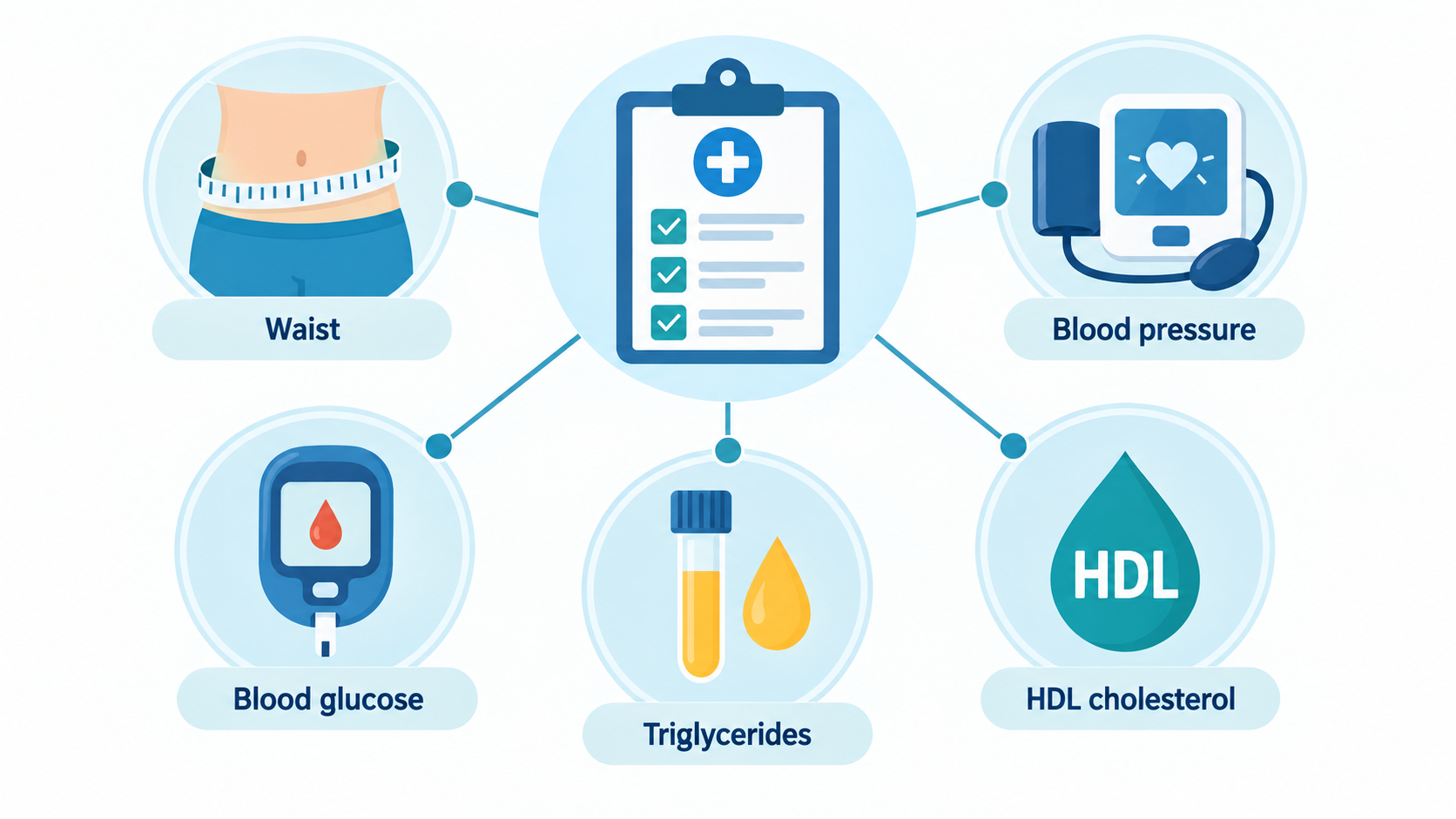
    Metabolic syndrome is a cluster of findings that together raise the risk of cardiovascular disease, type 2 diabetes, stroke, and other health problems. The National Heart, Lung, and Blood Institute (NHLBI) says a clinician may diagnose it when three or more of five conditions are present. Those conditions are a large waistline, elevated blood pressure, elevated fasting glucose, elevated triglycerides, and low HDL cholesterol. Our separate guide explains the five metabolic syndrome criteria in more detail.

    The phrase “metabolic syndrome blood panel” can therefore be misleading. There is no single universal panel with that name. A clinician usually combines a physical assessment with a glucose test and a lipid panel. The exact order may vary based on your history, medications, symptoms, prior results, and what your insurance plan covers.

    Five metabolic syndrome measurements: waist circumference, blood pressure, blood glucose, triglycerides, and HDL cholesterol
    Metabolic syndrome is assessed using five measurements; insurance coverage depends on why each test is ordered and how it is billed.

    The five measurements, in plain English

    MeasurementCommon threshold used for metabolic syndromeDoes it require fasting?Typical insurance question
    Waist circumferenceMore than 40 in (102 cm) for men or 35 in (88 cm) for women; ethnicity-specific cutoffs may differNoUsually part of an office assessment rather than a separate lab claim
    Blood pressure130/85 mm Hg or higher, or treatment for high blood pressureNoScreening may be preventive; evaluation or management can generate a visit charge
    Fasting glucose100 mg/dL or higher, or treatment for elevated glucoseYes, when specifically ordered as fasting plasma glucoseAsk whether the order is preventive diabetes screening or diagnostic testing
    Triglycerides150 mg/dL or higher, or treatment for elevated triglyceridesFollow the ordering clinician’s instructionsOften included in a lipid panel; preventive frequency limits may apply
    HDL cholesterolBelow 40 mg/dL for men or below 50 mg/dL for women, or treatmentFollow the ordering clinician’s instructionsUsually included in a lipid panel rather than billed alone
    Thresholds summarize commonly used adult criteria. Clinicians may apply population-specific waist cutoffs and interpret results in context.

    The NHLBI diagnostic guide describes these measurements and notes that waist cutoffs may vary by race and ethnicity. One result also does not diagnose diabetes by itself in an asymptomatic person. The National Institute of Diabetes and Digestive and Kidney Diseases (NIDDK) explains that abnormal diabetes testing is usually confirmed with a second measurement.

    Which metabolic syndrome blood tests should you ask about?

    1. Fasting plasma glucose

    This is the glucose measurement used in the classic metabolic syndrome criteria. NIDDK says it is usually performed in the morning after at least eight hours of fasting, with only sips of water. A result from a home glucose meter cannot diagnose diabetes.

    2. A lipid panel

    A standard lipid panel commonly reports triglycerides and HDL cholesterol, as well as total and LDL cholesterol. Triglycerides and HDL are the two components used for metabolic syndrome. LDL is important for cardiovascular risk management, but it is not one of the five metabolic syndrome criteria.

    3. A1C, when clinically appropriate

    An A1C estimates average blood glucose over roughly three months and usually does not require fasting. It can screen for prediabetes or diabetes, but it does not directly replace fasting glucose in every definition of metabolic syndrome. It can also be less reliable in some situations, including certain anemias, hemoglobin variants, recent blood loss, kidney failure, or pregnancy. Your clinician should decide whether fasting glucose, A1C, or another test best answers the clinical question.

    A continuous glucose monitor is not normally required to diagnose metabolic syndrome. If you are comparing self-pay options for glucose tracking, see our guide to CGM cost without insurance.

    Will insurance cover metabolic syndrome blood tests?

    Often, at least part of the evaluation is covered—but “covered” and “free” are not the same. HealthCare.gov says Marketplace plans and many other plans cover specified preventive services without copayment or coinsurance, generally when the service is delivered by an in-network provider. Its adult list includes blood pressure screening, cholesterol screening for eligible adults, type 2 diabetes screening for certain adults with overweight or obesity, and obesity screening and counseling. The page also warns that zero-dollar coverage is not guaranteed in every case.

    The U.S. Preventive Services Task Force currently recommends screening asymptomatic adults ages 35 to 70 who have overweight or obesity for prediabetes and type 2 diabetes. Yet your plan document, network rules, and the way the claim is coded still matter. A plan may treat a test differently if you already have diabetes, high cholesterol, hypertension, symptoms, an abnormal prior result, or a medication that needs monitoring.

    Preventive screening versus diagnostic testing

    This distinction causes many surprise bills:

    • Preventive screening looks for disease in someone without symptoms who meets guideline and plan criteria.
    • Diagnostic testing evaluates a symptom, abnormal result, suspected condition, or known disease.
    • Monitoring follows an already diagnosed condition or treatment.

    The same laboratory test can fall into any of these categories. The difference may affect deductible and coinsurance. The ordering clinician—not the patient—selects the diagnosis and reason for the order, and the insurer adjudicates the claim. You should not ask anyone to change accurate coding simply to avoid a charge. Instead, ask for an estimate based on the clinically correct order.

    What does Medicare cover for metabolic syndrome blood tests?

    Original Medicare handles the glucose and lipid portions under separate benefits:

    • Diabetes screening: Medicare Part B covers eligible glucose screenings when a clinician determines that you are at risk. Medicare lists high blood pressure, abnormal cholesterol or triglycerides, obesity, and a history of high blood sugar among qualifying risk factors. Covered tests may include fasting or nonfasting glucose, A1C, or another Medicare-approved glucose test. Medicare.gov states that eligible beneficiaries can receive up to two screenings per year and pay nothing when the provider accepts assignment.
    • Cardiovascular screening: Part B covers blood tests for cholesterol, lipid, and triglyceride levels once every five years. Medicare.gov says you pay nothing when the provider accepts assignment.
    • Annual Wellness Visit: the visit includes blood pressure, weight, BMI or waist measurement when appropriate, and a personalized prevention plan. However, the visit itself does not automatically bundle every laboratory test. Labs must qualify under their own coverage rules, as the CMS guidance makes clear.

    Medicare Advantage plans must cover Medicare-covered services but can use plan networks and administrative rules. Call the number on your plan card for the lab network and expected cost. If an abnormal glucose result identifies prediabetes, some beneficiaries may also qualify for the Medicare Diabetes Prevention Program.

    A five-minute call that can prevent a surprise bill

    Call your insurer before the blood draw. Use the exact test names on the order and ask:

    1. Is the ordering clinician in network?
    2. Is the laboratory in network? Hospital-owned labs and independent labs may have different rates.
    3. Are fasting plasma glucose, A1C, and the lipid panel covered as preventive screening for me?
    4. Do age, risk-factor, or frequency rules apply?
    5. Will I owe a deductible, copay, or coinsurance if the order is diagnostic or for monitoring?
    6. Do I need a referral or prior authorization?
    7. Can you give me a call reference number or written estimate?

    You can also ask the clinic: “Which tests are being ordered, which lab will process them, and can you send me the order so I can request a plan estimate?” If you are paying cash, request the self-pay price in writing and compare it with your expected in-network cost. A low cash price may not count toward your deductible.

    How to prepare for metabolic syndrome blood tests

    • Confirm whether fasting is required. If fasting plasma glucose is ordered, NIDDK advises at least eight hours without food; follow the lab’s exact instructions.
    • Ask about medications. Do not stop prescribed medicine on your own. Ask whether to take morning medicines and supplements before testing.
    • Bring prior results. Trends can be more informative than one isolated value.
    • Wear practical clothing. A correct waist measurement is taken around the abdomen, not over a bulky jacket.
    • Rest before blood pressure measurement. Tell the clinician about caffeine, exercise, smoking, pain, or stress that may affect the reading.

    A complete assessment should not reduce you to a single number. Our complete obesity evaluation guide explains how history, body measurements, complications, sleep, medications, barriers, and personal goals fit together.

    What if metabolic syndrome blood tests are abnormal?

    One abnormal value is a reason for a clinical conversation, not a self-diagnosis. Your clinician may repeat a measurement, confirm that the test was performed correctly, assess medications and other causes, or order additional tests. Metabolic syndrome is a risk framework; each component also deserves individual management.

    If three or more criteria are present, the next step is usually to address overall cardiovascular and diabetes risk rather than chase a label. That can include nutrition, physical activity, sleep, tobacco cessation, weight management, and treatment of blood pressure, glucose, or lipids when appropriate. If cost or coverage blocks care, tell the clinic. A feasible plan may use an in-network lab, covered preventive services, staged testing, or a different follow-up schedule.

    Frequently asked questions

    Is there one blood test for metabolic syndrome?

    No. Assessment combines waist circumference, blood pressure, fasting glucose, triglycerides, and HDL cholesterol. The last three involve laboratory testing.

    Do I need to fast?

    You need to fast for a fasting plasma glucose test. An A1C does not usually require fasting. Lipid-testing instructions can vary, so follow the order and laboratory directions rather than guessing.

    Will an annual physical include these labs for free?

    Not necessarily. Your plan may cover specific preventive screenings, but the office visit and each laboratory service have separate coverage rules. Original Medicare’s Annual Wellness Visit is not the same as a routine physical and does not automatically include clinical laboratory tests.

    Can I use home readings?

    Home blood pressure logs can provide useful context, but diagnosis should be confirmed with a clinician using a validated device and proper technique. A consumer glucose meter or CGM cannot by itself diagnose diabetes or metabolic syndrome.

    Bottom line

    Metabolic syndrome blood tests are only part of the workup: clinicians also measure waist and blood pressure, then check fasting glucose, triglycerides, and HDL. The billing can be less simple. Ask whether each service is preventive or diagnostic, verify both clinician and lab networks, and request an estimate. That preparation is often more useful than searching for a generic “metabolic panel,” which may not contain the tests needed to evaluate metabolic syndrome.

    Sources and further reading

    Medical and insurance information notice: This article provides general educational information and does not replace individualized medical advice, diagnosis, treatment, or a coverage determination from your insurer. Benefits, networks, billing rules, and clinical recommendations can change. Confirm current details with your clinician, laboratory, and health plan.

  • Home Sleep Apnea Test Cost: Insurance and Lab Comparison

    Quick answer

    Your home sleep apnea test cost depends on the service package, your insurance benefits, and whether another test is needed. Home testing suits some adults with suspected obstructive sleep apnea; other situations require in-lab testing. AASM diagnostic guideline.

    Before booking, get two things: your clinician’s recommendation for the test type and a written estimate that includes interpretation and follow-up. A low advertised device price does not answer either question. This US guide helps you compare the complete testing pathway—not just the first bill.

    Key takeaways

    • Start with the clinical question. Ask what the proposed test can establish and what happens if it does not provide an answer.
    • “Covered” is not the same as free. Check your deductible, network, and share of the allowed amount. HealthCare.gov: deductibles.
    • Compare like-for-like estimates. Include the consultation, test, interpretation, and results visit where applicable.
    • Keep a backup plan. Ask about the next step and its cost before accepting a home-testing package.

    Why sleep testing belongs in a metabolic-health conversation

    Sleep and weight discussions can quickly turn into promises about hormones or quick fixes. A more useful question is whether persistent symptoms deserve a clinical evaluation. Loud snoring, witnessed breathing pauses, gasping, and daytime sleepiness are reasons to discuss sleep apnea with a healthcare professional; they are not a diagnosis by themselves. NHLBI: sleep apnea symptoms.

    Bring a short record of your sleep schedule, daytime sleepiness, and anything a partner has noticed. The clinician may review your medicines, medical history, and other explanations for symptoms. A sleep diary can help that conversation. NHLBI: diagnosis.

    For related context, our guide to metabolic syndrome’s five criteria explains a separate assessment. Do not use that checklist to diagnose sleep apnea, or a sleep test to diagnose metabolic syndrome.

    Home sleep apnea test vs. in-lab sleep study

    An in-lab sleep study is often called polysomnography, or PSG. It can record brain activity, breathing, oxygen levels, heart rate, and movements overnight. Your clinician decides which testing approach suits the question being investigated. NHLBI: sleep studies.

    Compare the test and the pathway—not just the location
    Question Home sleep apnea testing (HSAT) In-lab polysomnography (PSG)
    Where? At home with a prescribed testing device. Overnight at a sleep-testing facility.
    What is recorded? A more limited set of signals; the exact measurements depend on the device. More detailed sleep and body measurements, including brain activity.
    What should I ask? Is this device and pathway suitable for my situation? What question requires the additional measurements?
    What belongs in the quote? Device, delivery or pickup, interpretation, results visit, and any repeat-test policy. Facility charge, clinician interpretation, consultation, and any separate follow-up.
    If the result is unclear? Ask in advance how the clinician arranges the next step. Ask who reviews the result and discusses further testing if needed.

    Clinical comparison: NHLBI and AASM’s 2018 HSAT position statement. The quote checklist is our practical planning aid, not a claim that every provider bills every item separately.

    When a home test may not be the right first step

    The AASM recommends home testing or PSG for uncomplicated adults with symptoms suggesting increased risk of moderate-to-severe obstructive sleep apnea. It favors PSG for people with significant cardiorespiratory disease, possible sleep-related hypoventilation, respiratory muscle weakness from neuromuscular disease, chronic opioid use, a history of stroke, or severe insomnia. These are clinical decisions, not a self-screening checklist. AASM diagnostic guideline, recommendations 2 and 4.

    Also, an automatically generated score is not the whole medical service. AASM’s position statement calls for appropriate clinical evaluation and physician interpretation of the raw home-test data. Ask who orders the test, who interprets it, and how you will discuss the findings. AASM HSAT position statement.

    How to estimate your home sleep apnea test cost

    There is no single price in this guide because a cash package, a hospital charge, and an insurer-negotiated amount are different comparisons. A useful estimate starts with the exact provider, ordered test, and billing arrangement.

    If you are using insurance

    Ask the testing provider for the proposed billing codes, the billing entities, and the place of service. Then ask your insurer to estimate your responsibility for those details. A deductible is the amount you pay for applicable covered care before the plan begins sharing costs; coinsurance is a percentage of covered costs. Individual benefits can differ. Deductible and coinsurance definitions.

    Home sleep apnea test cost: a worked example

    Illustrative calculation—not a market price or personal quote: suppose a covered, in-network test has a $600 allowed amount, you have $200 of deductible left, and your coinsurance is 20%. Assume no separate copay, no other charges, and that your out-of-pocket maximum does not change the calculation.

    • Remaining deductible: $200.
    • Amount left after that deductible: $600 − $200 = $400.
    • Coinsurance: 20% × $400 = $80.
    • Estimated patient share: $200 + $80 = $280.

    This is an original worked example using HealthCare.gov’s explanation of coinsurance. Your insurer must confirm the applicable benefits. Request separate estimates for any services excluded from the quoted package.

    If you are paying cash

    For a useful home sleep apnea test cost comparison, ask for an itemized, written self-pay estimate. Specifically ask whether the price includes the clinician visit, device, shipping or pickup, interpretation, and results discussion. Then ask what a failed recording or an additional lab test would cost. Do not assume a discount covers a second attempt.

    Under federal rules, people who are uninsured or not using insurance usually have a right to a good faith estimate when they request one or schedule care at least three business days ahead. CMS advises requesting an estimate from each involved provider or facility. If one provider’s bill is at least $400 above its estimate, you may qualify for the federal dispute process; it generally must be started within 120 days of receiving the initial bill. Check the eligibility details and keep both documents. CMS: rights when not using insurance.

    Does Medicare cover sleep apnea tests?

    Medicare Part B covers eligible Type I, II, III, and IV sleep tests and devices for people with clinical signs and symptoms of sleep apnea. A doctor or other healthcare provider must order the test. Type I testing is covered only in a sleep lab. Under Original Medicare, you generally pay 20% of the Medicare-approved amount after the Part B deductible; other insurance, assignment, and the facility can affect what you owe. Medicare.gov: sleep studies.

    When calling, state your exact coverage—not just “I have Medicare.” Ask the provider and plan to confirm the proposed test and your estimated share. This article does not provide a plan-specific Medicare Advantage quote.

    Copy this checklist before you book

    Use this as a note on your phone. Fill the blanks with answers from the clinician, testing service, and insurer, rather than trying to infer coverage from an advertisement.

    1. Clinical plan: Which test was ordered, and why is it appropriate for me? __________
    2. Billing details: What are the proposed codes, billing entities, and place of service? __________
    3. Network: Has my insurer confirmed the testing facility and interpreting clinician’s network status for this service? __________
    4. Approval: Does my plan require a referral or prior authorization, who obtains it, and has it been completed? __________
    5. Complete price: What is included, what is separate, and what is my estimated responsibility? __________
    6. Unsuccessful recording: Whom do I call if a sensor falls off, and what is the repeat-test policy? __________
    7. Unclear result: Who decides the next step, and how will any additional test be priced? __________
    8. Results: When and how will I receive my report and follow-up appointment? __________

    A short insurance-call script

    “My clinician has ordered a sleep apnea test. I have the proposed billing codes and provider details. Can you confirm whether this service is covered at this location, whether authorization is needed, and my estimated cost after my remaining deductible? Does your estimate include the clinician’s interpretation? Please give me the call reference number and tell me where I can find the relevant policy.”

    Record the date, representative’s name, and reference number. If the insurer and provider give different answers, ask them to reconcile the specific code or billing entity before you commit. An estimate is planning information, not a promise about the final claim.

    What if a home test is negative but symptoms continue?

    For suspected obstructive sleep apnea, AASM recommends PSG after one negative, inconclusive, or technically inadequate home test. Discuss the next step with your clinician. AASM diagnostic guideline, recommendation 3.

    Ask: “Was the recording usable? Does the result explain my symptoms? What happens next?” If you are sleepy enough to be unsafe behind the wheel, do not drive; arrange other transport and seek prompt clinical advice. NHLBI: living with sleep apnea.

    Where Zepbound fits—and where it does not

    The FDA approved Zepbound (tirzepatide) in December 2024 for moderate-to-severe obstructive sleep apnea in adults with obesity, alongside a reduced-calorie diet and increased physical activity. That is a defined indication, not a reason to assume every person who snores needs medication. FDA approval announcement.

    If treatment coverage is your next question, see our weight-loss medication insurance guide. Treat diagnostic testing and prescription coverage as separate questions to verify with your plan. Do not change an existing sleep-apnea treatment based on a coverage article.

    Frequently asked questions

    Should I choose the cheapest advertised home test?

    First compare what is included and whether the ordering clinician recommends that pathway. Our checklist is designed to help you compare complete offers. A device-only price and a package with consultation and interpretation are not equivalent quotes.

    Can a watch or snoring app replace the prescribed test?

    Do not treat a consumer sleep score as a diagnosis. Ask your clinician whether information from your particular device is useful. The medical pathway described here requires appropriate assessment and interpretation, not just an automatic score. AASM position statement.

    Does the home sleep apnea test cost include treatment?

    Ask explicitly. Request separate figures for any later device, supplies, medication, or follow-up that is not included. Keep the diagnostic estimate and the treatment estimate as separate entries in your budget.

    What should I do today?

    Write down your symptoms, arrange a clinical discussion, and save the booking checklist. Once the test is ordered, request the billing details and an itemized estimate. You do not need to guess the diagnosis before asking those questions.

    Sources and editorial notes

    Clinical recommendations above draw on the AASM’s 2017 diagnostic guideline and 2018 home-testing position statement, plus NIH patient information. These are not presented as new 2026 trials. Cost-sharing and consumer-rights details were checked against US government sources on the date shown above.

    This article was prepared with AI-assisted research and drafting. It is a general US testing-and-cost guide, not an individual diagnosis, medical recommendation, or guarantee of insurance coverage. No independent scientific review is claimed for this article. Ask your healthcare professional about testing and treatment, and your insurer or provider about your specific benefits and charges.

  • Does Insurance Cover Weight Loss Medication in 2026? A Practical GLP-1 Guide

    Does Insurance Cover Weight Loss Medication in 2026? A Practical GLP-1 Guide

    Quick answer: Weight loss medication coverage varies by plan. Insurance sometimes covers prescription treatment, but payment depends on the exact drug and formulation, the diagnosis being treated, and whether you complete requirements such as prior authorization. A prescription by itself does not guarantee payment.

    To understand weight loss medication coverage, the fastest way to get a reliable answer is not to ask, “Do you cover GLP-1 drugs?” Ask whether your plan covers the exact product for your specific FDA-approved indication, then request the written coverage policy and prior-authorization form. This guide explains how to do that, what evidence your clinician may need, and how to respond if the claim is denied.

    The answer depends on four separate questions

    1. Does your plan include anti-obesity medications? Some plans exclude the entire benefit category, even when they cover other prescription drugs.
    2. Is the exact drug on the formulary? Coverage may differ by brand, dose, device, and formulation.
    3. Is it being prescribed for a covered indication? The same active ingredient can be sold under different brand names with different FDA-approved uses.
    4. Have you met the utilization rules? Prior authorization, step therapy, quantity limits, network-pharmacy rules, and renewal criteria can all affect payment.

    Why the name on the prescription matters

    “Semaglutide” or “tirzepatide” is not enough information for an insurance check. Insurers adjudicate the specific product and indication. For example, the FDA labels Wegovy for chronic weight management and certain additional indications, while the Ozempic label is centered on type 2 diabetes and related cardiovascular and kidney-risk reduction. Similarly, Zepbound is approved for chronic weight management, whereas Mounjaro is labeled for type 2 diabetes.

    ProductActive ingredientSelected FDA-approved use relevant to coveragePractical insurance implication
    WegovySemaglutideChronic weight management; cardiovascular-risk reduction in qualifying adults; additional labeled usesMay be evaluated under an obesity benefit or another covered indication, depending on the plan
    ZepboundTirzepatideChronic weight management; moderate-to-severe obstructive sleep apnea in adults with obesityAsk which indication and clinical criteria the plan uses
    OzempicSemaglutideType 2 diabetes and related labeled risk-reduction usesUse solely for weight loss may be treated as off-label and denied
    MounjaroTirzepatideType 2 diabetesUse solely for weight loss may be treated as off-label and denied
    FDA labels evolve. Confirm the current label and your plan policy rather than assuming that drugs with the same ingredient are interchangeable.

    Zepbound also has an FDA-approved indication for moderate-to-severe obstructive sleep apnea in adults with obesity. That does not guarantee coverage, but it can change which policy and documentation apply. Your clinician should identify the medically appropriate, labeled indication rather than trying to “game” the claim.

    Weight loss medication coverage by insurance type

    Employer-sponsored and other commercial plans

    Two people with the same insurance company can have different benefits because employers often choose different prescription designs. One plan may cover anti-obesity drugs with prior authorization; another may exclude them. Start with the Summary Plan Description or pharmacy benefit materials, then call the number on the prescription card. For employer plans, the U.S. Department of Labor recommends consulting the plan documents and following the plan’s claims and appeal procedures.

    Marketplace and individual plans

    Review the plan’s drug formulary and Summary of Benefits and Coverage. HealthCare.gov advises members to check whether a medicine is covered, what it costs, and whether an exception process is available. Marketplace plans must provide a way to appeal many adverse benefit decisions, but that process cannot necessarily override a clearly written benefit exclusion.

    Medicaid

    Medicaid prescription coverage is state-specific. Check your state Medicaid agency’s current preferred drug list and prior-authorization criteria. Do not assume that a policy in a neighboring state applies to you. The federal State Prescription Drug Resources page is a useful starting point.

    Medicare weight loss medication coverage in 2026

    As of September 4, 2026: the CMS Medicare GLP-1 Bridge is a temporary nationwide demonstration running from July 1, 2026 through December 31, 2027 for eligible Medicare Part D beneficiaries. CMS states that eligible participants pay a $50 monthly copay and must obtain prior authorization.

    Current Bridge products listed by CMS include certain formulations of Foundayo, Wegovy, and Zepbound; the list may change. Clinical eligibility includes adults with obesity or overweight who meet specific BMI and comorbidity criteria. People using a GLP-1 for another coverable Part D indication—such as type 2 diabetes, qualifying obstructive sleep apnea, or certain liver-disease indications—may need to seek coverage through their Part D plan rather than the Bridge.

    Check the current Medicare consumer guidance and CMS Bridge criteria before acting. These details are time-sensitive.

    How to check weight loss medication coverage: six steps

    1. Collect the exact prescription details

    • Brand name and active ingredient
    • Formulation and strength
    • Diagnosis or FDA-approved indication being treated
    • Prescriber’s name and contact information

    2. Search the current formulary

    Use the formulary for the current plan year—not an old PDF found through a general web search. Search for the brand name and review the notes for tier, prior authorization, step therapy, quantity limits, age limits, and specialty-pharmacy requirements. If the drug is absent, look for the plan’s formulary-exception process.

    3. Call the pharmacy-benefit number

    “I am checking coverage for [exact drug, formulation, and strength] for [diagnosis/indication]. Is anti-obesity medication included or excluded under my plan? Is this product on the current formulary? What tier is it, and does it require prior authorization, step therapy, quantity limits, or a specific pharmacy? Please send me the written policy and prior-authorization form, and give me a reference number for this call.”

    Also ask for your expected cost after the deductible, whether coinsurance is based on the negotiated price, and what renewal criteria apply. Record the date, representative’s name, and call reference number.

    4. Read the clinical criteria before the appointment

    Requirements vary, but policies may ask for a documented BMI, qualifying weight-related conditions, previous treatment attempts, participation in lifestyle modification, or reasons that preferred alternatives are inappropriate. These are plan rules, not universal medical standards. For context on cardiometabolic risk documentation, see our guide to the five metabolic syndrome criteria.

    5. Give your clinician the actual form

    Do not rely on a generic note saying “medically necessary.” A strong submission answers each question in the plan’s policy and may include:

    • Baseline and current weight, height, and BMI
    • Relevant diagnoses and objective clinical history
    • The FDA-approved indication being treated
    • Previous therapies, outcomes, adverse effects, or contraindications when the policy asks for them
    • Why a formulary alternative is expected to be less effective or unsafe, when applicable
    • A monitoring and follow-up plan

    6. Confirm approval before filling the prescription

    Ask for the authorization number, start and end dates, approved dose or quantity, required pharmacy, and renewal criteria. Approval does not always mean a low copay; verify your actual out-of-pocket amount before the pharmacy dispenses the medicine.

    Steps for checking coverage, prior authorization, and appealing a weight-loss medication denial
    A practical path from formulary check to prior authorization and appeal.

    If weight loss medication coverage is denied

    Denial reasonWhat it usually meansUseful next step
    Benefit exclusionThe plan excludes anti-obesity drugs as a categoryConfirm the exact exclusion in writing. An appeal may not overcome plan design; ask an employer benefits team about future coverage options.
    Non-formulary drugThe product is not on the covered listAsk about preferred alternatives and whether a formulary exception is available.
    Incomplete prior authorizationRequired fields or records were missingRequest the denial details and resubmit a complete packet promptly.
    Step therapy not completedThe plan requires a preferred treatment firstDocument the trial, failure, adverse effect, or clinical reason the required step is inappropriate.
    Indication not coveredThe diagnosis or use does not meet the policyVerify coding and the labeled indication; discuss a covered, medically appropriate alternative with the clinician.
    Renewal criteria not metThe plan requires a specified response or follow-upSubmit objective progress data, or discuss whether continuing treatment is clinically appropriate.

    How to appeal a denial

    1. Get the denial in writing. You need the reason, policy language, clinical criteria, appeal deadline, and submission route. Do not rely only on what the pharmacy screen says.

    2. Match the response to the reason. Ask the prescriber to address the specific missing criterion and attach relevant records. For a non-formulary request, explain why covered alternatives would be less effective, have caused adverse effects, or are contraindicated when that is medically accurate.

    3. File on time and keep a complete copy. HealthCare.gov states that an internal appeal generally must be filed within 180 days of receiving a denial. Include the denial or Explanation of Benefits, the appeal request, supporting clinician letters, records, and a log of calls. Your plan documents control the actual deadline.

    4. Request external review if eligible. If an internal appeal remains denied, an independent external review may be available. HealthCare.gov says the request is generally due within four months of the final denial; urgent cases may qualify for an expedited process.

    Medicare Part D exception: CMS allows requests for a non-formulary drug or for waiver of certain utilization rules. A prescriber’s supporting statement is important. CMS lists a standard decision timeframe of 72 hours, or 24 hours for an expedited request, after the supporting statement is received.

    Medicare GLP-1 Bridge exception: CMS says there is no formal appeal process for a Bridge prior-authorization denial. The provider may resubmit corrected or additional information, so obtain the precise reason and respond to it quickly.

    What to do if the drug is not covered

    • Ask about covered alternatives. The best alternative depends on your medical history, other medications, contraindications, and treatment goals.
    • Compare total cost, not only the coupon headline. Check the in-network pharmacy price, deductible, coinsurance, cash price, follow-up visits, and supplies.
    • Verify manufacturer program rules directly. Eligibility and terms can change, and government-insurance restrictions often apply.
    • Revisit employer benefits during enrollment. If the issue is a categorical exclusion, the benefits team—not the pharmacy—may be the relevant decision-maker.
    • Be cautious with compounded products. The FDA warns that unapproved compounded semaglutide and tirzepatide are not reviewed for safety, effectiveness, or quality in the same way as approved drugs. Use a state-licensed pharmacy and consider compounding only when a clinician determines that an approved product cannot meet the patient’s medical need.

    Frequently asked questions

    Does a prescription guarantee insurance coverage?

    No. A prescription indicates that a clinician ordered the drug; it does not establish that the plan includes the benefit, lists the product, or considers the patient eligible under its policy.

    Does insurance cover Ozempic for weight loss?

    Many plans evaluate Ozempic under its FDA-approved type 2 diabetes indications. Use solely for weight loss may be considered off-label and denied. Coverage is plan-specific, so check the exact formulary and policy. Wegovy contains semaglutide but has different labeled indications; it is not automatically covered either.

    Can my employer add weight-loss medication coverage?

    Potentially. For self-funded or employer-selected benefit designs, the employer or benefits consultant may influence which categories are included. Ask the benefits team whether the exclusion is an employer plan-design decision and whether it will be reviewed for the next plan year.

    Does Medicare cover weight-loss medication in 2026?

    Some eligible Part D beneficiaries can access selected products through the temporary Medicare GLP-1 Bridge beginning July 1, 2026, subject to prior authorization and clinical criteria. Other FDA-approved indications may be covered through the regular Part D benefit. Verify current CMS rules because the demonstration and product list are time-limited.

    How long does prior authorization take?

    It varies by plan and by whether the request is standard or urgent. Ask the plan when its review clock begins and what makes a submission complete. Do not confuse commercial-plan timelines with Medicare Part D exception timelines.

    Bottom line

    Weight loss medication coverage becomes easier to verify when the question is specific. The most useful question is not “Does insurance cover weight-loss drugs?” It is: “Does my current plan cover this exact product, for this diagnosis, under these clinical criteria, at this pharmacy, and at what out-of-pocket cost?” Get the answer in writing, give the correct policy to the prescriber, and treat a denial as a document with a specific reason—not as the end of the process.


    Sources and further reading

    Written and edited by: Denny Jaeyong Choi (JD), INSEAD MBA
    Last updated: September 7, 2026

    Medical information notice: This article provides general educational information and does not replace individualized medical advice, diagnosis, or treatment. Coverage rules change and your plan documents control. Discuss treatment decisions with a qualified clinician and verify benefits directly with your insurer.