
Quick answer: Medicare Wegovy coverage is available to some beneficiaries in 2026, but the route depends on why the drug is prescribed. For weight management alone, eligible Part D beneficiaries can use the temporary Medicare GLP-1 Bridge and pay $50 per 28- or 30-day fill. Prescriptions for type 2 diabetes, moderate-to-severe obstructive sleep apnea, qualifying MASH, or cardiovascular risk reduction must go through regular Part D instead. Both routes may require prior authorization.
Published: September 5, 2026 · Last updated: September 7, 2026
The difference matters. A claim sent down the wrong path can create delays, confusing denials, and unnecessary phone calls. This guide explains the eligibility rules, the exact order of the Bridge process, the documents worth gathering, and what to do if coverage is denied.
Key takeaways
- Weight-management prescription: use the GLP-1 Bridge if the beneficiary meets the plan, BMI, diagnosis, and lifestyle-program criteria.
- Part D-covered medical indication: use the regular Part D coverage-determination and exception process—not the Bridge.
- Bridge cost: $50 per covered monthly fill, but it does not count toward the Part D deductible or annual out-of-pocket limit.
- Correct sequence: the pharmacy submits the initial Bridge claim before the prescriber sends prior authorization.
How does Medicare Wegovy coverage work in 2026?
Since July 1, 2026, Medicare has operated a nationwide, time-limited demonstration called the Medicare GLP-1 Bridge. CMS currently says the program will run through December 31, 2027. It is available to eligible people with qualifying Medicare drug coverage in all states and U.S. territories.
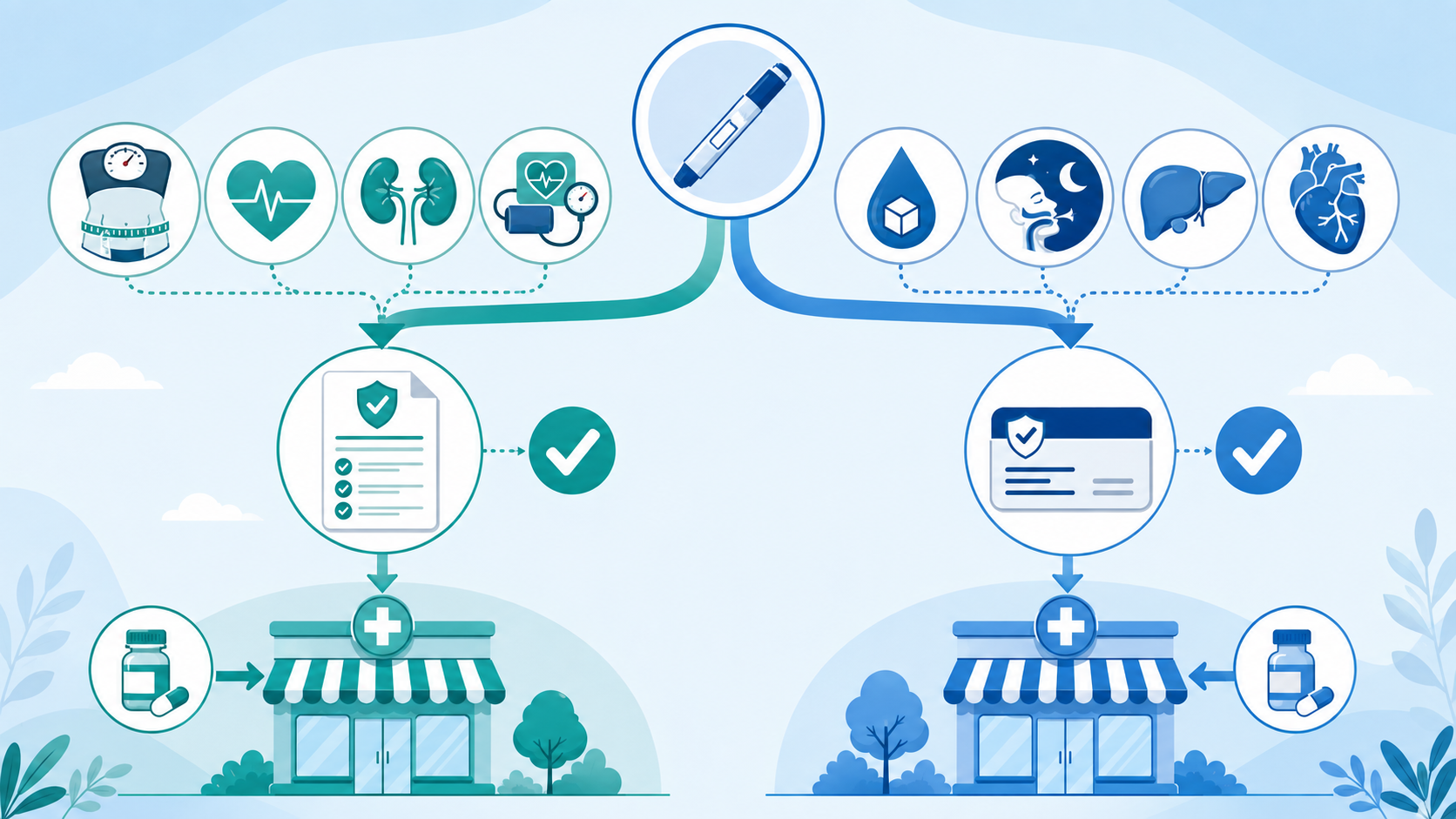
The Bridge does not turn weight-loss drugs into ordinary Part D benefits. It operates outside the normal Part D payment and coverage flow, using a central processor for eligibility, prior authorization, pharmacy claims, and payment. That creates two possible routes:
| Why the GLP-1 is prescribed | Coverage route | What the patient should expect |
|---|---|---|
| To reduce excess body weight and maintain weight reduction | Medicare GLP-1 Bridge, if all eligibility criteria are met | $50 copay per 28- or 30-day fill after approval |
| Type 2 diabetes | Regular Part D plan | Plan formulary, utilization-management, exception, and appeal rules apply |
| Moderate-to-severe obstructive sleep apnea in an adult with obesity | Regular Part D plan | The plan evaluates the FDA-covered indication supported by the SURMOUNT-OSA trials |
| Noncirrhotic MASH with moderate-to-advanced fibrosis | Regular Part D plan | The plan evaluates the covered indication and clinical documentation |
| Reduction of major cardiovascular events in a patient who meets the approved indication | Regular Part D plan | The indication is supported by the SELECT cardiovascular outcomes trial; Part D coverage determination or a formulary exception may still be needed |
Practical rule: start with the diagnosis and treatment purpose written on the prescription—not simply the brand name. The same medicine can follow a different coverage route for a different FDA-approved use.
Medicare Wegovy coverage is therefore route-specific: the diagnosis and intended use determine whether the request belongs with the Bridge processor or the beneficiary’s Part D plan.
The clinical evidence and the insurance pathway answer different questions. SELECT tested cardiovascular outcomes with semaglutide in adults with established cardiovascular disease and overweight or obesity without diabetes, while SURMOUNT-OSA evaluated tirzepatide in adults with obesity and moderate-to-severe obstructive sleep apnea. These trials help explain the approved medical indications; they do not guarantee that an individual Part D plan will approve a particular prescription.
Who qualifies for Medicare Wegovy coverage through the GLP-1 Bridge?
A beneficiary must have an eligible form of Medicare drug coverage, be at least 18 years old, receive the drug for weight reduction together with ongoing nutrition and physical-activity support, and meet one of the CMS clinical thresholds at the time GLP-1 therapy began.
| BMI at treatment initiation | Additional clinical requirement |
|---|---|
| 35 or higher | No additional condition is listed in the Bridge’s BMI pathway |
| 30 or higher | At least one: heart failure with preserved ejection fraction; uncontrolled hypertension despite two antihypertensive medicines; or chronic kidney disease stage 3a or higher |
| 27 or higher | At least one: prediabetes; previous heart attack; previous stroke; or symptomatic peripheral artery disease |
CMS defines uncontrolled hypertension for this program as systolic pressure above 140 mm Hg or diastolic pressure above 90 mm Hg despite concurrent treatment with two blood-pressure medicines. Do not assume that a current lower BMI automatically disqualifies someone who started therapy earlier: CMS says eligibility is evaluated using the criteria at the time GLP-1 therapy was initiated. The prescriber still needs accurate records supporting that history.
Eligible plan types
Examples include standalone Part D prescription drug plans, coordinated-care Medicare Advantage plans with drug coverage, Special Needs Plans, employer or union group waiver plans, and the LI NET program. Some special plan types are excluded unless the person is also enrolled in an eligible standalone prescription drug plan. If your plan type is unclear, call 1-800-MEDICARE before asking the medical office to start paperwork.
Who should use regular Part D instead?
The Bridge is specifically for weight management. CMS states that a beneficiary who has type 2 diabetes, moderate-to-severe sleep apnea, or qualifying MASH should obtain the GLP-1 through the Part D plan for that condition, even if the plan does not currently list the requested drug on its formulary. That is where the Part D coverage-determination and formulary-exception process becomes important.
A second exclusion can surprise people: if Medicare data show that a Part D plan already paid for a GLP-1 fill during 2026, the beneficiary is generally not eligible for the Bridge in 2026 and should continue through the Part D plan. Cash-paid use outside Medicare is a different situation; verify the facts with 1-800-MEDICARE rather than guessing.
Which drugs and formulations qualify for Medicare Wegovy coverage?
As of September 5, 2026, the Medicare beneficiary page lists Foundayo tablets, Wegovy injections and tablets, and Zepbound KwikPen. The current FDA Wegovy prescribing information describes the approved formulations, indications, contraindications, and safety warnings. The FDA Zepbound prescribing information does the same for tirzepatide. The Bridge specifically excludes Zepbound single-dose vials and single-dose pens. CMS can update the product and National Drug Code list, so a familiar brand name is not enough: ask the pharmacy to confirm that the prescribed package and formulation match the current Bridge list.
For a broader comparison of current cash-pay options, see our Wegovy vs. Zepbound self-pay guide. If you have employer insurance or an ACA plan rather than Medicare, use our general weight-loss medication coverage guide.
What does the $50 copay include—and not include?
Under Medicare Wegovy coverage through the Bridge, an eligible beneficiary pays $50 for each covered monthly supply. CMS pharmacy guidance says only 28-day or 30-day fills are covered, not longer fills. The amount remains $50 regardless of the beneficiary’s income or current Part D benefit phase.
Three limits are easy to miss:
- The $50 does not count toward the Part D deductible.
- It does not count toward the Part D annual out-of-pocket limit, also called true out-of-pocket or TrOOP spending.
- Extra Help does not reduce the Bridge copay, and coupons or discount programs cannot be combined with a Bridge claim.
The $50 is the medicine copay, not an all-inclusive treatment price. Office visits, nutrition services, laboratory testing, or management of side effects can have separate coverage and cost-sharing rules.
How to start a Medicare Wegovy coverage request
The order is unusual. A prescriber should not submit the Bridge prior authorization before the pharmacy sends the initial claim. CMS provider instructions warn that an early authorization request can return a “patient not found” error.
- Confirm the coverage route. Ask whether the prescription is for weight management or a Part D-coverable medical indication.
- Confirm eligible drug coverage. Verify that you have an eligible Part D or Medicare Advantage drug plan.
- Ask the prescriber to document the starting criteria. The chart should support BMI at GLP-1 initiation, any qualifying condition, the weight-management purpose, and ongoing lifestyle modification.
- Send the prescription to the pharmacy. The pharmacy submits the claim to the Bridge processor and receives the prior-authorization trigger.
- Wait for the authorization request. CMS says the pharmacy typically sends it to the prescriber electronically or by fax within 24 to 72 hours. If nothing arrives after 72 hours, the prescriber can use the CMS fax form.
- The prescriber completes the authorization. Approval or denial is sent to the prescriber and mailed to the beneficiary, generally within 72 hours after submission.
- The pharmacy dispenses the approved product. The beneficiary pays $50 for the covered monthly fill.
CMS says a Bridge authorization generally remains valid for refills and dose changes through December 31, 2027, unless the beneficiary switches to a different GLP-1 drug. A switch requires a new authorization.
Prior-authorization checklist for the medical visit
Bring or verify the following before the prescription is sent:
- Medicare card and current drug-plan card
- Current medication list and the name of any GLP-1 used in 2026
- Documented weight, height, and BMI when GLP-1 treatment began
- Records supporting prediabetes, previous heart attack or stroke, symptomatic peripheral artery disease, heart failure with preserved ejection fraction, resistant hypertension, or chronic kidney disease stage 3a or higher
- A brief charted plan for structured nutrition and physical activity
- The exact requested drug and formulation
- The preferred pharmacy’s phone and fax information
Do not ask a clinician to select a diagnosis merely to fit the program. The prescriber attests under penalty of perjury that the information is accurate, and CMS may compare the request with Medicare data.
What to do if Medicare Wegovy coverage is denied
If the Bridge prior authorization is denied
Read the denial reason first. CMS says the Bridge has no formal appeal process. However, the prescriber may resubmit the authorization if information was incorrect, incomplete, updated, or newly available. A useful response is specific: correct the BMI date, attach the qualifying diagnosis, confirm the weight-management indication, or document the lifestyle program—whichever item caused the denial.
If the Part D plan denies a coverable indication
This is a different process. A beneficiary, prescriber, or representative may request a coverage determination and, when appropriate, a formulary exception. The prescriber must explain why covered alternatives would be less effective or could cause adverse effects. If the decision is unfavorable, the notice should explain how to request redetermination.
Do not let the two denial systems blur together: a Bridge denial can be corrected and resubmitted but has no Bridge appeal; a regular Part D denial carries the plan’s determination, exception, and appeal rights.
A practical phone script
When calling the plan, pharmacy, or medical office, use a short question that identifies the route:
“My prescription is for [weight management / a specific covered condition]. Should this claim go through the Medicare GLP-1 Bridge or my Part D plan? Has the pharmacy submitted the initial claim, and is the prior authorization waiting with my prescriber?”
If the status is unclear, ask for the rejection or authorization reason verbatim, the date it was sent, the destination fax or electronic portal, and the next responsible party. Write down names, dates, and reference numbers.
Medicare Wegovy coverage: frequently asked questions
Does Medicare automatically cover Wegovy for weight loss?
No. A beneficiary must have eligible drug coverage, meet the Bridge’s clinical criteria, receive Wegovy for weight management with ongoing lifestyle modification, and complete prior authorization. A different indication may need to go through Part D.
Does Medicare cover Zepbound for sleep apnea?
A prescription for moderate-to-severe obstructive sleep apnea in an adult with obesity should be evaluated through the Part D plan, not the weight-management Bridge. Formulary status and utilization-management rules still matter, and an exception request may be necessary.
Will Extra Help reduce the $50 Bridge copay?
No. CMS says the low-income subsidy does not apply to the Bridge copay because the demonstration operates outside the Part D benefit.
Can I use a manufacturer coupon with the Bridge?
No. CMS says coupons and discount programs cannot be applied to Bridge claims.
Do I need a new authorization after a dose increase?
Not ordinarily. Medicare.gov says the authorization remains valid for refills and dose changes through December 31, 2027, unless you switch GLP-1 drugs.
Where can I check my eligibility or authorization status?
Use the eligibility questions on Medicare.gov or call 1-800-MEDICARE (1-800-633-4227). TTY users can call 1-877-486-2048.
Bottom line
Medicare Wegovy coverage in 2026 is real, but it is not one universal benefit. The fastest path begins by matching the prescription’s purpose to the correct system: Bridge for eligible weight-management use, regular Part D for an already coverable medical indication. Then follow the Bridge sequence precisely—prescription to pharmacy, initial claim, prior-authorization request, prescriber response—and keep documentation of BMI at treatment initiation and qualifying conditions.
Sources
- Centers for Medicare & Medicaid Services: Medicare GLP-1 Bridge overview
- Medicare.gov: Weight-loss drug coverage, eligibility, products, and costs
- CMS: Medicare GLP-1 Bridge information for providers
- CMS: Medicare GLP-1 Bridge information for Part D plans
- CMS: Part D formulary and tiering exceptions
- U.S. Food and Drug Administration: Wegovy prescribing information, revised 2026
- U.S. Food and Drug Administration: Zepbound prescribing information, revised 2026
- Lincoff et al.: Semaglutide and Cardiovascular Outcomes in Obesity without Diabetes (SELECT), New England Journal of Medicine
- Malhotra et al.: Tirzepatide for the Treatment of Obstructive Sleep Apnea and Obesity (SURMOUNT-OSA), New England Journal of Medicine
Written and edited by: Denny Jaeyong Choi (JD), INSEAD MBA.
Last updated: September 7, 2026
Medical and insurance disclaimer: This article provides general educational information and does not replace individualized medical advice, a coverage determination, or the terms of a Medicare plan. Drug indications, program rules, formularies, and costs can change. Confirm current eligibility and coverage with Medicare, your plan, your prescriber, and your pharmacy before making treatment or financial decisions.