Tag: prediabetes

  • Medicare Diabetes Prevention Program in 2026: Who Qualifies and How to Enroll

    Published: September 24, 2026 · Last updated: September 24, 2026

    Quick answer

    The Medicare Diabetes Prevention Program (MDPP) offers a year of structured lifestyle support at no cost to eligible people with Medicare Part B. You need a qualifying blood test, the required BMI, and no prior diagnosis of type 1 or type 2 diabetes or end-stage renal disease. An approved supplier must deliver the program. Check the official Medicare eligibility and cost rules.

    Two 2026 changes are worth checking: the old once-per-lifetime limit has ended, and approved self-paced online programs are now a covered option. However, self-paced and live classes follow different delivery rules. This guide explains what to ask before you enroll.

    A clinician says your blood sugar is in the prediabetes range. You leave with advice to eat differently and move more—but little help turning that advice into a Tuesday afternoon. MDPP is designed to provide that practical support. The challenge is finding the right program and confirming that it is the Medicare benefit, not a separate paid wellness subscription.

    Key takeaways

    • Check the actual lab result. MDPP’s fasting-glucose threshold differs from the usual prediabetes threshold.
    • Ask about current rules. Older pages may still say you can participate only once in your life.
    • Confirm the supplier and format. A prevention app or a CDC-recognized class is not automatically a Medicare-enrolled MDPP supplier.
    • Choose support you can use. Transportation, class timing, technology, language, and coach access matter as much as a program’s name.

    What changed in the Medicare Diabetes Prevention Program in 2026?

    First, the Consolidated Appropriations Act, 2026 removed the once-per-lifetime limit on February 3, 2026. CMS says this applies to both Original Medicare and Medicare Advantage. Previous participation therefore does not, by itself, rule you out. You still need to meet the applicable eligibility requirements. Ask the supplier how a new course fits your previous service dates.

    Second, CMS added coverage for asynchronous—self-paced, non-live—online delivery starting January 1, 2026, through December 31, 2029. Live video classes remain a different format. These are earlier-2026 changes, not a new law announced this week. We checked them against the CMS MDPP FAQ, last modified September 22, 2026.

    Who qualifies for the Medicare Diabetes Prevention Program?

    You need Part B coverage and must meet the following conditions. One qualifying test is enough for the blood-test requirement; you do not need all three. The test must fall within the 12 months before your first core session. The supplier verifies your eligibility using the Medicare coverage criteria.

    On a small screen, swipe the table sideways if needed.

    MDPP eligibility: what to have ready
    RequirementCurrent rulePractical check
    Medicare coveragePart B; Medicare Advantage also covers this benefit.Have your coverage details ready. Ask an Advantage plan about its network.
    One qualifying lab testA1C 5.7–6.4%; or fasting plasma glucose 110–125 mg/dL; or two-hour oral glucose tolerance test 140–199 mg/dL.Keep the result, test type, and date—not just a note saying “prediabetes.”
    TimingQualifying test within 12 months before the first core session.Check the planned start date, not only the day you call.
    Body mass indexBMI at least 25, or at least 23 for Asian participants.Ask what height and weight documentation the supplier needs.
    Medical historyNo prior type 1 or type 2 diabetes diagnosis or end-stage renal disease.Discuss your history with your clinician and supplier. Prior gestational diabetes is a different category.

    The easy-to-miss difference: 100 versus 110

    NIDDK lists the usual fasting-glucose prediabetes range as 100–125 mg/dL. MDPP’s qualifying fasting result starts at 110 mg/dL. Thus, a fasting result of 105 alone does not meet that particular MDPP route. However, a qualifying A1C or two-hour test may meet the lab requirement. These tests do not always identify the same people. See NIDDK’s diagnostic ranges and Medicare’s separate benefit thresholds.

    This is a coverage distinction, not a reason to dismiss an abnormal result or order extra tests yourself. Ask your clinician to interpret the results you already have. For related billing questions, see our guide to metabolic blood tests and insurance.

    What does the Medicare Diabetes Prevention Program cost?

    Medicare says you pay nothing for MDPP if you qualify. Use an approved Medicare supplier. If you have Medicare Advantage, confirm any in-network requirement before starting. A commercial app subscription, gym membership, or separate nutrition package is not automatically this covered service. Ask the organization to distinguish MDPP sessions from optional purchases. The official benefit page is the starting point for that conversation.

    Likewise, a blood test is a separate service. Medicare covers eligible diabetes screenings at no charge when the provider accepts assignment, subject to its screening rules. That does not make every office visit or lab panel free. Before testing, ask what the clinician is ordering and how the lab will bill it. See Medicare’s diabetes-screening benefit.

    In person, live video, or self-paced online?

    The word “online” can hide two very different experiences. A scheduled video group is distance learning: everyone attends live. In contrast, an asynchronous program lets you work through content on your own schedule. Under current CMS delivery rules, you can combine in-person and live distance-learning sessions, but you cannot mix self-paced online delivery with those live formats within the same set of MDPP services.

    Choose a format you can sustain
    FormatWhat it involvesAsk before enrolling
    In personScheduled classes with a coach and peers.Where are sessions? What happens if transport or illness prevents attendance?
    Live distance learningScheduled live sessions remotely; can combine with in-person sessions.Which device and connection are needed? Is technical help available?
    Self-paced onlineNon-live lessons on your schedule, with human coach interaction offered.How do I contact my coach? How are participation and weight documented?

    Self-paced does not mean “just watch videos.” CMS requires suppliers to offer live human coach interaction during weeks when a participant engages with content. Two-way email or text can count; a chatbot does not. Ask for a concrete example of that support. Virtual delivery options currently extend through December 31, 2029; availability still depends on participating suppliers. See the CMS online-delivery FAQ.

    What happens during the year?

    Medicare covers up to 22 sessions within 12 months: up to 16 weekly core sessions in the first six months, followed by six monthly sessions. The focus is lasting changes in food choices, activity, and weight management—not a crash diet. Medicare describes trained coaching and peer support for live formats. CDC gives practical examples such as adapting familiar foods and planning around holidays. See Medicare’s session outline and CDC’s explanation of the program.

    You do not have to achieve 5% weight loss to keep receiving the covered core and maintenance sessions during this service period. CMS explicitly says suppliers must provide them to eligible participants regardless of reaching that milestone. However, Medicare pays for sessions attended, and the 12-month window still matters. Discuss missed sessions early rather than assuming they automatically roll over. CMS explains attendance and continuation rules here.

    How to enroll in the Medicare Diabetes Prevention Program

    1. Gather the basics

    Find your Medicare coverage details, qualifying lab report and date, current height and weight information, and any previous MDPP dates. Then ask your clinician whether the program fits your health needs. CMS does not require an MDPP referral, but a provider referral is needed for tests billed under the diabetes-screening benefit. Do not confuse the two. Source: CMS referral guidance.

    2. Find an approved supplier

    Start with the “Find providers” tool on Medicare’s MDPP page. Search by location and filter by class format. Community organizations may offer the benefit as well as health care providers. If nearby options are limited, check approved online programs rather than assuming a commercial app qualifies.

    3. Confirm coverage before the first session

    Ask the supplier to verify your eligibility and confirm that it will provide and bill MDPP. If you have Medicare Advantage, contact the plan as well. Keep the person’s name, date, and any reference number. If you participated before, mention that immediately and ask about the current repeat-participation rules.

    4. Check the everyday details

    Request the start date, schedule, language options, accessibility support, make-up policy, and coach contact method. Also ask how the program documents weight and attendance. For online classes, establish who helps with technical problems. These questions test whether the program fits your life—not whether you have enough willpower.

    5. Save your confirmation and check any bill

    Keep a copy of what the supplier confirms about coverage and optional charges. If a bill arrives unexpectedly, ask which service it covers and whether it is MDPP or something separate. Then contact the supplier and, where relevant, your plan before assuming the charge is correct. Do not ignore a bill while you investigate it.

    What benefit is supported by research?

    The landmark Diabetes Prevention Program trial randomized 3,234 adults at high risk of diabetes. Over an average 2.8 years, intensive lifestyle support reduced diabetes incidence by 58% relative to placebo. Rates were 4.8 versus 11.0 cases per 100 person-years. That is a relative reduction in a studied population—not a promise that every enrollee’s personal risk falls by 58%. Read the original 2002 trial abstract.

    Importantly, that trial was not a direct test of every current MDPP supplier or the new self-paced format. Its intervention, participants, and follow-up differ from routine Medicare delivery. It supports structured lifestyle prevention, but does not prove all class formats perform equally. For broader background, see NIDDK’s DPP research overview.

    A device is also a different intervention from a year of coaching. If you are considering buying a sensor instead, our CGM and weight-loss evidence review separates device effects from bundled lifestyle support.

    Frequently asked questions

    Can I join again if I have already used MDPP?

    Prior participation is no longer a lifetime exclusion. The limit ended on February 3, 2026. However, eligibility and the rules for a course of services still apply. Ask the supplier to verify your record and proposed start date; do not interpret this as unlimited overlapping sessions. Source: CMS.

    Does Medicare Advantage cover the program?

    Yes. CMS says an Advantage plan must offer MDPP even if it has a similar supplemental prevention benefit. You may need an in-network supplier, so confirm this with your plan. CMS explains the distinction; Medicare explains network considerations.

    What if I already have type 2 diabetes?

    MDPP is not the entry program for someone with established type 2 diabetes. Ask instead about diabetes self-management training. That separate Part B benefit requires a provider order and a diabetes diagnosis. Under Original Medicare, its usual cost is 20% of the approved amount after the Part B deductible; other coverage can affect what you owe. See Medicare’s self-management training rules.

    What if diabetes develops after I start?

    CMS says participants who develop diabetes while receiving MDPP can continue the services for which they remain eligible. Tell your clinician and supplier so your diabetes care is addressed too. Continuing prevention-program sessions is not a substitute for appropriate treatment. Source: CMS beneficiary FAQ.

    Does MDPP approval also cover weight-loss medication?

    No—do not use approval for a lifestyle program as proof of drug coverage. These are different benefits with different requirements. For that separate question, see our Medicare Wegovy and GLP-1 coverage guide, and confirm current drug coverage with your plan.

    Sources and further reading

    1. Medicare.gov: MDPP eligibility, costs, session structure, and supplier search.
    2. CMS: MDPP frequently asked questions, including 2026 repeat-participation and online-delivery rules.
    3. CDC: Preventing Type 2 Diabetes with Medicare.
    4. NIDDK: Diabetes Tests & Diagnosis.
    5. Medicare.gov: Diabetes screenings.
    6. Medicare.gov: Diabetes self-management training.
    7. Diabetes Prevention Program Research Group. NEJM, 2002. DOI: 10.1056/NEJMoa012512.
    8. NIDDK: Diabetes Prevention Program research overview.

    How this guide was prepared

    This is a practical coverage guide, not a systematic review or a comparison of individual suppliers. We checked the official Medicare, CMS, CDC, and NIDDK pages linked above on September 24, 2026. For the trial’s numerical results, we used its PubMed abstract; we did not reanalyze participant data. In addition, current CMS and Medicare guidance took priority over older descriptions of the lifetime limit. Supplier availability, plan networks, and future rules may change.

    Update history: September 24, 2026 — First publication; includes the 2026 repeat-participation change and the distinction between live and self-paced delivery.

    Written and edited by: Denny Jaeyong Choi (JD), INSEAD MBA

    Medical information notice: This article provides general health and coverage information, not personal medical advice or a determination of insurance eligibility. Discuss test results and care with a qualified clinician. Confirm coverage and enrollment with Medicare, your plan, and the approved supplier.
  • CGM for Weight Loss Without Diabetes: What the Evidence Shows

    CGM for Weight Loss Without Diabetes: What the Evidence Shows

    Evidence review note: This review of CGM for weight loss is the English-language edition of an Aether Health evidence review originally published in Korean. It uses the same evidence base and conclusions, with terminology and practical questions adapted for U.S. readers. Material differences will be documented when either edition is updated.

    Quick answer: A continuous glucose monitor (CGM) may help some adults without diabetes change eating or activity habits when it is used inside a structured program. But the evidence does not show that simply wearing a sensor reliably causes weight loss. A 2026 systematic review included 23 studies and 1,074 participants without diabetes, yet only three studies contributed to its pooled BMI analysis—and that analysis did not find a statistically clear BMI benefit. Original review.

    Which effect is being estimated? A trial with similar nutrition support in both arms, but visible versus blinded CGM data, estimates the added effect of access to glucose feedback within that care setting. It does not test an unsupported sensor alone. A sensor-plus-coaching package versus a different control cannot identify the sensor’s separate contribution. Basiri’s 30-person, 30-day trial illustrates the first comparison; its participants had prediabetes, so it should not be generalized automatically to normal-glucose adults. Original trial abstract and comparison conditions.

    Published: September 16, 2026 · Original evidence review: September 16, 2026 · Targeted source check: October 6, 2026 · Editorial clarification last updated: October 11, 2026
    Written and edited by: Denny Jaeyong Choi (JD), INSEAD MBA
    Scientific review of the September 16 version: Pierre Theurey, PhD

    Key takeaways

    • “Twenty-three studies” does not mean 23 weight-loss trials. The studies asked different questions, and only three were pooled for BMI.
    • Several recent randomized trials reported encouraging short-term weight results, particularly when CGM was combined with nutrition counseling, exercise, an app, or professional coaching.
    • Package trials cannot separate sensor and support effects. Trials with similar support in both groups give a closer estimate of the added value of CGM feedback, but do not establish benefit from unsupported sensor use.
    • One 24-week pilot trial found no additional weight loss from CGM, reminding us that results are not uniformly positive.
    • The most defensible interpretation is that CGM can be a biofeedback tool for some people—not a stand-alone fat-loss treatment or a proven requirement for long-term weight maintenance.

    You eat lunch, open an app, and watch the glucose line rise. After dinner, you take a walk and see the line flatten. That immediate feedback feels persuasive. But two questions are easy to blur together:

    1. Can a sensor show how glucose changes after meals, sleep, stress, or activity?
    2. Does seeing those changes help a person lose more weight—and keep it off?

    The answer to the first question is clearly yes: displaying glucose patterns is what a CGM does. The second question is much less settled. This review focuses on adults who do not have diagnosed diabetes and are considering CGM for weight management, not on people using CGM as part of diabetes treatment.

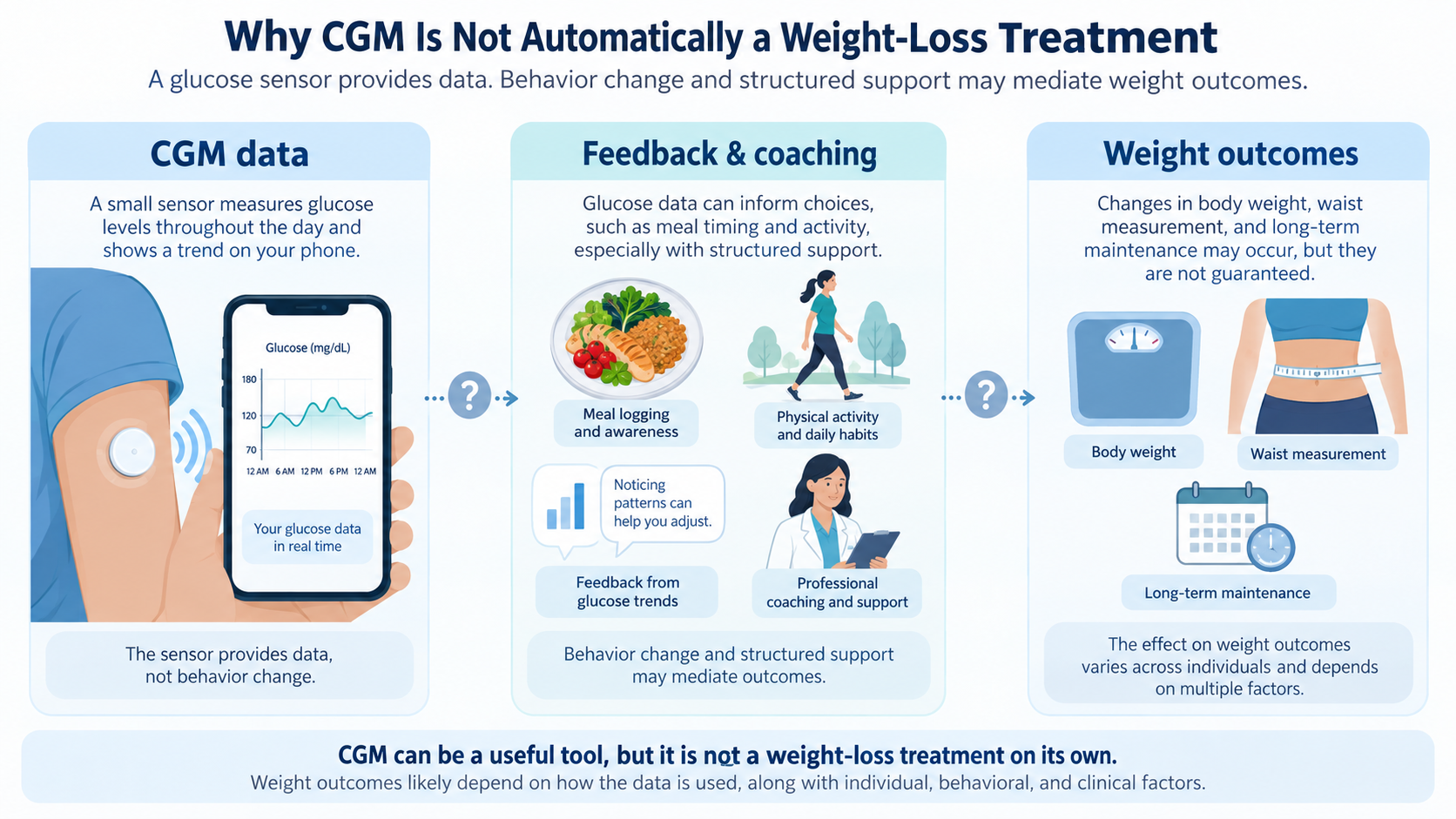
    Evidence pathway from CGM data through feedback and coaching to uncertain weight outcomes
    A CGM supplies data. Whether that data changes weight depends on behavior, support, individual factors, and time—not on the sensor alone.

    Why “23 studies” is not the same as 23 weight-loss trials

    A 2026 systematic review and meta-analysis by Liao and colleagues included 23 studies involving 1,074 people without diabetes across 11 countries. Seven were randomized controlled trials; the rest included observational, cross-sectional, cohort, and other clinical studies. The projects also had overlapping but different aims: glucose optimization, weight management, dietary behavior, adherence, measurement performance, or feasibility.

    The pooled BMI result came from only three studies. Its standardized mean difference was −0.25, with a 95% confidence interval from −0.63 to +0.12 (P=0.19). In plain language, the analysis did not establish a statistically clear BMI reduction. The number −0.25 is a standardized effect size, not “0.25 kilograms lost,” and the confidence interval includes both a possible benefit and no meaningful difference.

    The same review found a modest improvement in mean glucose overall, with more signal in participants with prediabetes than in normoglycemic participants. It also reported short-term behavior and adherence signals. That is useful—but improved glucose metrics, lower body weight, and long-term weight maintenance are three different outcomes. A favorable result for one should not be silently converted into proof of the others.

    Better question: Instead of asking “How many CGM studies exist?” ask “How many studies directly compared the weight outcome I care about, in people like me, for long enough to matter?”

    What randomized trials of CGM for weight loss actually tested

    The trials below are especially relevant to CGM and weight, but they did not test identical interventions or populations. Their weight changes should not be ranked as if every study were the same experiment.

    StudyParticipants and durationWhat was comparedWeight result and limitation
    Kitazawa et al., 2024168 adults at high risk for type 2 diabetes; 12 weeksSmartphone lifestyle coaching plus intermittently scanned CGM versus controlAmong 136 participants with weight-change data: −1.70 kg versus −0.77 kg. The app, coaching, and sensor effects cannot be separated.
    Basiri & Cheskin, 202430 adults with prediabetes and overweight or obesity; 30 daysBoth groups received personalized nutrition therapy; one group could see real-time CGM dataBoth groups lost weight; the visible-data group had larger reductions. Very small and short, with intensive nutrition support in both groups.
    Gradiser et al., 202635 women with BMI above 25; 12 weeksBoth groups received supervised exercise three times weekly and identical dietary counseling; CGM exposure differedMean change −5.5 kg versus −0.2 kg. Encouraging, but from a small, specific population and not yet a long-term test.
    OWL-CGM, 202649 adults who had already lost more than 5 kg; 24 weeksBoth groups received five individual dietitian sessions; one also received CGM and trainingAmong 41 completers: −2.7 kg versus +0.5 kg. A feasibility trial in successful weight losers, not a fully powered effectiveness trial.
    Nishikage et al., 202540 adults with overweight and impaired glucose tolerance or mild type 2 diabetes; 24 weeksDiet and exercise therapy with or without intermittently scanned CGM−1.8 kg versus −2.2 kg; no significant between-group difference. Included some participants with mild diabetes, so it is indirect evidence for people without diabetes.

    The central problem: sensor effect versus program effect

    Several positive trials studied a bundle: CGM plus an app, personalized nutrition, dietitian visits, exercise supervision, goal setting, or education about how to act on the readings. A bundle may be valuable in real life, but it does not answer how much of the result came from the sensor.

    Kitazawa’s trial illustrates the issue. Weight was a secondary outcome, and fewer people contributed weight data than entered the primary analysis population. The roughly 0.93 kg difference between the groups can be calculated from the reported changes, but it should not be relabeled as “weight lost because of CGM.” The intervention included app-based coaching.

    OWL-CGM offers a somewhat cleaner clue because both groups received individual dietitian counseling. The CGM group also received the sensor and training, and the result remained favorable in a sensitivity analysis accounting for missing data. Still, it was a small feasibility study. Its participants had already lost more than 5 kg, so their experience may not apply to someone starting weight management for the first time.

    The plausible mechanism is behavioral, not magical: data may make a meal, snack, walk, or sleep pattern feel more immediate. That feedback can help some people notice and repeat useful habits. But feedback can also be ignored, misread, or become overwhelming. The sensor supplies information; a person and their support system must decide what to do with it.

    Why one negative trial matters

    Evidence reviews become misleading when they collect only studies with exciting results. In Nishikage’s 24-week pilot trial, both groups received diet and exercise therapy. Adding intermittently scanned CGM did not produce greater weight loss: average changes were −1.8 kg with CGM and −2.2 kg in the control group.

    This is not definitive proof that CGM “does not work” for people without diabetes. The trial was small, baseline BMI differed between groups, and the population included impaired glucose tolerance as well as mild type 2 diabetes. It is more appropriately used as evidence that outcomes do not always move in the same direction.

    A better way to interpret your CGM graph

    If weight management is the goal, keep three scorecards separate:

    1. Glucose metrics: Did mean glucose, post-meal patterns, or time in a chosen range change?
    2. Weight-related outcomes: Did body weight, waist measurement, body composition, or another personally meaningful outcome change?
    3. Durability: Did useful behavior and weight changes remain after intensive coaching or sensor use ended?

    The trials reviewed here lasted from 30 days to 24 weeks. That is not enough to establish one-year maintenance or prevention of future disease. “Without diabetes” is also not one uniform population: a person with normal glucose, someone with prediabetes, an adult with obesity, and someone who recently lost substantial weight do not start from the same place.

    At present, the stronger hypothesis is not that a sensor burns fat. It is that real-time feedback may help some people change behavior, particularly when paired with a plan and support. We still need larger comparisons that hold counseling constant, identify who benefits most, follow participants after the sensor is removed, and measure whether the added benefit justifies the cost and burden.

    Who might reasonably try a CGM for weight loss?

    There is no validated checklist that can predict who will lose weight with CGM. The questions below translate the current evidence into a practical decision—not a medical screening tool.

    • Is the behavior question specific? “I want to be healthier” is difficult to test. “Can meal logging and a short walk after dinner help me build a repeatable routine?” is more actionable.
    • Will you pair data with a plan? A sensor is more likely to be useful when readings inform a defined nutrition, activity, sleep, or coaching program.
    • Have you compared lower-cost alternatives? The same budget might fund dietitian visits, a structured activity program, or other support. Current trials do not establish which option is most cost-effective.
    • Are you measuring the outcome that matters? A smoother glucose curve is not automatically weight loss. Track weight trends, waist or functional goals, behavior sustainability, cost, and mental burden.
    • Could the data worsen anxiety or food restriction? If readings drive fear, compulsive checking, or an increasingly narrow diet, stop treating every fluctuation as a problem and seek qualified guidance.

    For current U.S. OTC and prescription price examples, intended-use cautions, and insurance questions, see our guide to CGM cost without insurance. If you are mainly concerned about cardiometabolic risk, a CGM should not replace standard assessment; our guide to metabolic syndrome blood tests explains the laboratory and physical measurements clinicians commonly use.

    Safety and limits: what a consumer CGM cannot do

    • A CGM reading alone does not diagnose diabetes, prediabetes, reactive hypoglycemia, or insulin resistance.
    • Sensor glucose is measured in interstitial fluid and can lag behind blood glucose when levels change quickly.
    • Compression, insertion issues, hydration, exercise, and other factors can produce readings that do not match how you feel.
    • Do not start, stop, or change medication based on wellness CGM data without a qualified clinician.
    • If you already use CGM for diabetes treatment, the limited weight-loss evidence in this article is not a reason to discontinue it.

    Symptoms matter more than a wellness graph. Seek urgent medical care for severe confusion, fainting, seizure, breathing difficulty, or other acute symptoms. If repeated readings concern you, confirm what the device instructions recommend and discuss appropriate laboratory testing with a clinician rather than trying to diagnose yourself from the curve.

    Bottom line: promising feedback tool, not proven necessity

    Saying “CGM is all marketing” ignores encouraging recent trials. Saying “clinical trials prove everyone loses weight with CGM” erases differences in population, counseling, exercise, adherence, and study duration.

    The most accurate position is between those extremes. CGM may be a useful feedback tool within some structured weight-management programs. It is not an established stand-alone weight-loss treatment for every person without diabetes, and long-term effects after the sensor comes off remain uncertain.

    Which CGM comparison answers your question?

    The key distinction is not simply “CGM versus no CGM.” A trial may test a whole support package or the added value of visible glucose feedback within similar care. Neither design establishes what happens when someone buys a sensor and uses it without support.

    Read the comparator before interpreting the weight result
    QuestionRelevant evidenceBoundary
    Does a CGM-containing program help?Kitazawa: app-based lifestyle intervention plus isCGM, in adults at high diabetes risk.A package comparison; it cannot assign the benefit to the sensor alone.
    Does seeing the data add value?Basiri: visible versus blinded CGM, with personalized nutrition in both groups.Closer to a feedback comparison, but only 30 participants and 30 days—not unsupported sensor use.
    Does CGM add to maintenance counseling?OWL-CGM: counseling in both groups; sensor and training added in one.A promising feasibility result in previous weight losers; not a definitive long-term efficacy trial.

    A closer comparison is not no evidence. Trials that keep background care similar can estimate the incremental benefit of CGM feedback and its associated education. They still cannot establish a universal benefit, isolate every component, or show that buying a sensor replaces the program.

    The date and denominator behind the headline

    The Liao review searched through December 2025 and included ages 10–71, not exclusively adults. Its three-study BMI synthesis should not be presented as a pooled analysis of the later 2026 trials listed above. We discuss those trials separately; we have not recalculated the pooled effect.

    OWL-CGM randomized 49 people, but 41 completed follow-up. Its reported intention-to-treat sensitivity analysis also favored CGM, which reduces—but does not eliminate—concern about missing outcomes. Keep recruitment, completion, and analysis counts distinct. Original trial abstract and analysis description.

    What would make the conclusion stronger?

    Our editorial criteria are larger trials with similar background support, clear weight endpoints, follow-up after feedback ends, and separate results for normal glucose and prediabetes. Evidence that a glucose curve changed is not, by itself, evidence of sustained weight loss or disease prevention. These are proposed evidence needs, not a formal GRADE assessment.

    Related questions, not interchangeable answers: our Akkermansia maintenance review asks about a specific supplement after dieting; our fiber and SCFA review separates food interventions from metabolite supplements. Neither establishes that combining those approaches with CGM improves outcomes.

    Editorial clarification — October 11, 2026

    Added a near-summary explanation of feedback-with-matched-support versus package comparisons, using a selected recheck of Basiri’s public abstract. Existing study counts, effects, uncertainty, images, and overall conclusions are unchanged. This AI-assisted precision edit is not a new literature search or scientific review; Pierre Theurey’s credit remains limited to the September 16 version.

    Source check and revision record — October 6, 2026

    This targeted update checked the Liao publisher text and the PubMed records for Kitazawa, Basiri, and OWL-CGM. Full-text details and confidence intervals not verified in this update were not reconstructed from abstracts. The Gradiser and Nishikage entries remain from the earlier review; they were not fully re-extracted today. No exhaustive new search, independent duplicate extraction, or new meta-analysis was performed.

    Change: clarified package versus feedback comparisons, the review’s search cutoff and age range, and missing-outcome interpretation. The overall conclusion is unchanged. The September 16 scientific-review credit applies to that earlier version; no new article-specific review by Pierre Theurey is claimed for this October 6, AI-assisted source-check and editorial update.

    How this evidence review was conducted

    This is a question-focused evidence review, not a new systematic review, meta-analysis, clinical guideline, or independent replication of the included studies.

    • Question: In adults without diagnosed diabetes, do CGM-containing interventions improve weight loss or maintenance compared with another intervention? Weight outcomes were considered separately from glucose outcomes.
    • Search approach: Through September 16, 2026, we checked PubMed and journal records using concepts including continuous glucose monitoring, non-diabetic, prediabetes, weight loss, weight maintenance, randomized trial, and identified article titles. We did not run the same exhaustive strategy across every academic database.
    • Access: We checked the full systematic review and available full-text records for Kitazawa and Basiri. Public abstracts and indexed records were used for Gradiser, OWL-CGM, and Nishikage, with additional details checked where available. Abstract-only review cannot fully assess allocation concealment, missing-data handling, or selective reporting.
    • Limits: We did not perform dual independent screening, formal risk-of-bias scoring, GRADE certainty ratings, or a new pooled effect calculation. We did not add sample sizes across studies because participant overlap and differences in analysis populations were not fully audited. Relevant studies may have been missed.
    • Update trigger: We will revisit the conclusion if a sufficiently powered long-term comparison, post-sensor follow-up, major correction, or retraction changes the balance of evidence.

    Key references

    1. Liao X, et al. Continuous glucose monitoring in non-diabetic populations: a systematic review of observational and interventional studies with meta-analysis. European Journal of Medical Research. 2026.
    2. Kitazawa M, et al. Lifestyle Intervention With Smartphone App and isCGM for People at High Risk of Type 2 Diabetes: Randomized Trial. Journal of Clinical Endocrinology & Metabolism. 2024;109:1060–1070.
    3. Basiri R, Cheskin LJ. Personalized Nutrition Therapy without Weight Loss Counseling Produces Weight Loss in Individuals with Prediabetes Who Are Overweight/Obese. Nutrients. 2024;16:2218.
    4. Gradiser M, et al. Intermittently Scanned Continuous Glucose Monitoring Enhances Weight Loss and Adherence in Women with Obesity. Diabetes Technology & Therapeutics. 2026;28:907–915.
    5. Mohd Hatta NZ, et al. Optimizing Weight Loss Maintenance: Can Continuous Glucose Monitoring Play a Role (OWL-CGM)? Clinical Nutrition. 2026;64:106738.
    6. Nishikage S, et al. Effects of intermittently scanned continuous glucose monitoring on body weight and glycemic variability in individuals with overweight and impaired glucose tolerance or mild diabetes. Obesity Research & Clinical Practice. 2025;19:70–76.

    Review and conflict-of-interest disclosure

    Denny Jaeyong Choi and Pierre Theurey completed the editorial and scientific review of the September 16, 2026 version. The October 6 source-check and editorial additions are documented above; a new scientific review of those additions has not been confirmed. Both are co-founders of RockBio. According to the site operator, neither reviewer has a CGM product or app development business, equity holding, consulting fee, or sponsorship relationship relevant to this article. No affiliate purchase links are included. Editorial and scientific review are not the same as independent journal peer review. Reviewer backgrounds and our process are described on the About Metabolic Access page.

    Medical information notice: This article provides general education and research interpretation. It does not diagnose or treat diabetes, hypoglycemia, obesity, or any other condition and does not replace individualized care.