Tag: weight-loss medication

  • GLP-1 Muscle Loss: What Lean Mass and Strength Studies Actually Show

    Published: October 15, 2026 · Last updated: October 15, 2026

    You are losing weight on a GLP-1 medicine, but a headline says you may be losing muscle. Then your scan says your lean-mass percentage has improved. Can both be true? Yes. The useful question is not whether one number went up or down. It is what was measured, what changed compared with a control group, and whether everyday strength or function changed too.

    Quick answer

    GLP-1 muscle loss concerns deserve attention, but lean-mass loss is not the same as proven muscle failure. Semaglutide and tirzepatide body-composition studies report reductions in lean mass alongside larger reductions in fat. A scan alone does not establish loss of strength. Human studies that actually tested function show why both measurements matter. Plan nutrition, activity, and follow-up with your clinician rather than stopping treatment because of a headline. Tirzepatide DXA substudy; SEMALEAN; exercise and liraglutide trial analysis.

    Four things to keep separate

    • Lean mass versus skeletal muscle. Do not automatically relabel a body-composition result as an equal amount of contractile muscle lost.
    • Kilograms versus percentages. A smaller absolute amount can make up a larger share of a much smaller body.
    • Mass versus function. Grip strength, stair climbing, and a scan answer different questions.
    • Evidence versus advice. Sensible exercise and nutrition support does not mean every proposed protein dose or program has been proven with every medicine.

    What does “lean mass” actually tell you?

    Lean-mass measurements include more than skeletal muscle. In particular, DXA lean soft tissue includes organs and water as well as muscle; bone mineral is measured separately. It is not a direct test of how strongly a muscle contracts. Terminology also varies between reports, so read the study’s definition rather than assuming every use of “lean,” “fat-free,” and “muscle” means exactly the same thing. 2026 methodological discussion of DXA and muscle-health assessment.

    Sarcopenia is not simply a disappointing number on a scale. The EWGSOP2 clinical consensus emphasizes low strength, uses muscle quantity or quality to confirm the diagnosis, and uses poor physical performance to identify severe disease. That is a clinical framework, not a home diagnostic test or a GLP-1-specific trial. Original consensus, DOI 10.1093/ageing/afy169.

    Here is a purely mathematical example, not a trial result: someone weighing 100 kg with 50 kg of lean tissue has a 50% lean proportion. At 80 kg with 46 kg of lean tissue, the proportion is 57.5%. The percentage improved even though the absolute amount fell by 4 kg. Neither percentage alone tells us whether that person’s strength improved.

    What the human studies measured

    These are selected comparisons, not a ranking of medicines. Different populations, measurements, follow-up periods, and study designs prevent a fair head-to-head conclusion from these rows. On a phone, scroll inside the table.

    Population, comparison, outcome, and evidence boundary stay together
    Study and designFindingImportant limit
    STEP 1 exploratory DXA analysis, 2021
    140 adults without diabetes; 95 semaglutide / 45 placebo; 68 weeks.
    Semaglutide: weight −15.0%, fat mass −19.3%, lean mass −9.7%; lean share of body weight rose 3.0 percentage points. Placebo weight −3.6%.Conference-supplement abstract, not a full muscle-function report. Do not call a 9.7% lean-mass change a 9.7% strength loss.
    SURMOUNT-1 DXA substudy, 2025
    160 with baseline/end scans: 124 pooled tirzepatide / 36 placebo; 72 weeks.
    Weight −21.3% versus −5.3%; lean mass −10.9% versus −2.6%. Approximately 25% of weight lost was lean mass in both groups.Selected scan substudy, not all 2,539 parent-trial participants. Lean-mass proportion is not the proportion of starting muscle lost.
    SEMALEAN, 2026
    Prospective semaglutide cohort; 115 enrolled, 106 completed; 12 months.
    Lean mass fell about 3 kg by month 7, then stabilized. Handgrip strength increased 4.5 kg at month 12.Within-group changes, not placebo-adjusted effects. Does not prove semaglutide itself strengthens muscle.
    Jensen et al., 2026
    Secondary randomized-trial analysis; 193 adults without diabetes; 52 weeks after a diet run-in.
    Exercise plus liraglutide versus liraglutide alone: stair test 1.2 seconds faster (95% CI 0.6–1.9). Absolute strength was preserved across groups.Fitness outcome, not proof that every exercise program preserves muscle mass with semaglutide or tirzepatide.

    Why “25% muscle loss” can be misleading

    The tirzepatide report’s approximate 25% figure refers to the share of lost weight that was lean mass, not losing one-quarter of all starting muscle. Those denominators are different. The study was funded by Eli Lilly, and several authors were employees/shareholders; those disclosures matter when assessing replication. Its published correction changes Figure 4’s fat/lean change axis from percent to kilograms. Do not mix that figure’s units with the percentage results above. Original report and disclosures; correction, DOI 10.1111/dom.70050.

    Also ask whether a number is a change from baseline or a difference between groups. A treatment group can lose lean mass while improving its lean-to-fat ratio. Neither observation cancels the other. The responsible interpretation keeps both, rather than selecting the more reassuring or alarming statistic.

    Does lower lean mass necessarily mean lower strength?

    No. SEMALEAN is useful precisely because it measured both. However, its participants had a mean BMI of 46.3, and the cohort had no randomized untreated comparison. The abstract does not supply a confidence interval for the reported grip change. We should not translate that observation into a guaranteed response for older, frail, or less severely obese adults. SEMALEAN original abstract.

    The randomized liraglutide analysis asks a different question: what did adding structured exercise contribute? It reported better stair performance with the combination than medication alone; the 95% confidence interval above shows uncertainty around the mean difference. Exercise was moderate-to-vigorous, not a test of protein supplements alone. Novo Nordisk supplied medicine/placebo pens, and the paper lists foundation and institutional support. These results support measuring function, not assuming a scan captures it. Original analysis and funding statement.

    Does resistance training guarantee lean-mass preservation?

    “Guarantee” goes beyond the evidence. A 2025 dietary-weight-loss pilot randomized 48 adults to diet alone or diet plus home resistance exercise for 12 weeks; 39 completed. It found no significant between-group body-composition benefit, but strength and chair-stand performance improved with training. Body composition was assessed by bioimpedance and muscle thickness by ultrasound, not DXA. Small size and unmeasured exercise adherence limit interpretation. This was not a GLP-1 trial. Binmahfoz et al.; PMID 40760444.

    A null scan result does not make the functional benefit irrelevant. Conversely, stronger grip is not proof of larger muscles. When discussing a program, ask what it is intended to improve and how that will be checked. A plan can be worthwhile without promising a perfect scan.

    What remains unproven about protein and exercise together?

    The 2026 LEAN-PREP publication describes a six-month, four-group trial designed for 232 adults starting semaglutide or tirzepatide: usual care, resistance exercise, protein support, or both. Its primary outcome is MRI-measured quadriceps area. This publication is a protocol, not a result. Its planned 1.6 g/kg/day protein target should not be presented as a proven universal prescription. We did not verify current recruitment or results-posting status here. Protocol; DOI 10.1136/bmjopen-2026-116911.

    A separate 2026 expert consensus explicitly acknowledges that many supportive-care recommendations rely on indirect evidence and clinical experience. That does not make them useless. It means we should distinguish practical care guidance from a direct randomized demonstration in the exact population. Nutritional and lifestyle supportive-care consensus.

    A practical conversation plan for your next visit

    The following is a discussion checklist, not an individual exercise, protein, or medication prescription. Bring your treatment timeline and any body-composition report so the clinician can interpret the context rather than just one alarming percentage.

    1. Define the concern. Is it lower measured lean mass, new weakness, difficulty eating, or reduced ability to do usual tasks? Write down when it started and whether it is progressing.
    2. Check the measurement. Ask what the report measures, its units, whether the same method was used before, and whether a change is large enough to interpret confidently.
    3. Agree on a functional measure. Ask whether a standardized grip, chair-rise, or walking assessment would be useful. Do not improvise strenuous home tests if balance or mobility is a concern.
    4. Discuss what you can actually eat. Ask for a food-first nutrition assessment and an individualized protein plan, especially if low appetite or gastrointestinal symptoms make eating difficult. A supplement label is not a personalized care plan.
    5. Choose achievable activity and a review point. Ask what resistance activity is appropriate, how to progress it, and when to reassess intake, function, symptoms, and weight together.

    CDC’s general adult guidance includes 150 minutes of moderate aerobic activity and at least two days of muscle-strengthening activity each week. That is population guidance, not a guarantee of muscle preservation during medication treatment. Start from your abilities; people with chronic conditions should discuss appropriate types and amounts with their clinician. CDC activity guidance.

    Walking and resistance work answer different needs. Our post-meal walking evidence review focuses on glucose and timing, not proof of muscle retention. Likewise, probiotic GLP-1 claims do not establish a way to preserve muscle. Avoid treating a benefit in one domain as an answer to another.

    Frequently asked questions

    Should I stop a GLP-1 medicine because lean mass fell?

    A scan alone cannot make that decision. Discuss its meaning, treatment benefits, symptoms, and function with the prescriber. This review does not provide a dose change or stopping rule.

    Can lean percentage improve while I lose lean tissue?

    Yes. Percentage and absolute amount use different denominators. The arithmetic example above shows how this happens; it is not evidence that every such change is harmless.

    Is tirzepatide better than semaglutide for muscle?

    The studies compared here do not establish that. Comparing percentages from separate trials is not a randomized head-to-head muscle-health comparison.

    Does protein powder solve the problem?

    This review does not establish a powder, brand, or universal dose that prevents GLP-1 muscle loss. Ask what your actual intake and nutritional needs are before adding products.

    Does a lower lean-mass number mean sarcopenia?

    Not by itself. Clinical assessment considers strength, muscle quantity or quality, and performance; interpretation depends on the framework and the person. EWGSOP2 consensus.

    Bottom line

    Do not minimize a meaningful functional decline, and do not turn every lean-mass change into a diagnosis. The evidence supports asking two questions together: “What tissue measurement changed?” and “What can this person do?” A useful follow-up plan should answer both.

    Methods, access limits, and update history

    This targeted narrative comparison was prepared October 15, 2026, after checking the site’s 27 published titles for overlap. Focused web/PubMed discovery used “semaglutide lean mass muscle strength resistance exercise trial 2025 2026,” “tirzepatide body composition SURMOUNT-1,” and “LEAN-PREP.” We selected human body-composition and function comparisons, one dietary exercise pilot, a protocol, and methodological/official guidance. This is not a systematic review, exhaustive evidence inventory, independent duplicate extraction, or meta-analysis.

    Access: SEMALEAN and SURMOUNT-1 numerical findings were checked in original PubMed abstracts and available figure captions/disclosures. The STEP 1 source is a published conference-supplement abstract. Springer original pages were read for the exercise analysis’s abstract/funding and the pilot’s methods/results/limitations. The SURMOUNT correction text was available through indexed primary publisher/PMC records; direct full-page retrieval failed. LEAN-PREP and supportive-care consensus were used at abstract level; the latter was accessible through its indexed PubMed record. The DXA methodological discussion was assessed through its indexed publisher summary. Failed PMC browser checks were not counted as full-text access. Several endpoint-specific denominators, confidence intervals, supplements, and current registry results remain unverified. We did not pool effects or claim a complete correction-history audit of every source.

    Transparency: Prepared with AI assistance. The author works in healthcare and biotechnology. No affiliate purchase links or specific supplement recommendations are included. No independent scientific or medical review is claimed.

    Update history: October 15, 2026 — Initial publication; measurement denominators, mass-versus-function findings, a null body-composition result, and protocol-versus-results boundaries documented.

    Sources and further reading

    1. STEP 1 exploratory body-composition abstract, 2021. DOI 10.1210/jendso/bvab048.030.
    2. Look et al., SURMOUNT-1 DXA substudy, 2025. DOI 10.1111/dom.16275. Figure-axis correction.
    3. Alissou et al., SEMALEAN, 2026. DOI 10.1111/dom.70141.
    4. Jensen et al., physical fitness after exercise/liraglutide, 2026. PMID 41579235.
    5. Binmahfoz et al., home-based resistance pilot, 2025. PMID 40760444.
    6. Alawadhi et al., LEAN-PREP protocol, 2026. DOI 10.1136/bmjopen-2026-116911.
    7. 2026 nutritional/lifestyle supportive-care expert consensus; CDC adult activity guidance.
    8. EWGSOP2 definition/diagnosis consensus; 2026 DXA/functional-assessment discussion.

    Written and edited by: Denny Jaeyong Choi (JD), INSEAD MBA

    Medical information notice: General education only. This article does not diagnose muscle disease or prescribe medication changes, protein targets, or exercise. Discuss persistent weakness, difficulty eating, or declining daily function with a qualified clinician.

  • Can You Use an HSA for Weight Loss? 2026 HSA & FSA Guide

    Using an HSA for weight loss—or an FSA—may help with some expenses, but eligibility depends on why the expense was incurred, what was purchased, and what documentation your plan requires.
    Written and edited by Denny Jaeyong Choi (JD), INSEAD MBA
    Published September 11, 2026 · Sources checked September 11, 2026

    Quick answer

    A weight-loss program, nutritional counseling, or certain related expenses may be paid or reimbursed through an HSA or health FSA when the expense treats a specific disease diagnosed by a physician—such as obesity, diabetes, hypertension, or heart disease. The same purchase for appearance, general fitness, or overall well-being does not qualify under the IRS test. IRS wellness and medical-expense FAQ.

    Do not assume that a merchant’s “HSA/FSA eligible” badge guarantees reimbursement. Before paying, ask your account administrator whether the exact expense needs a prescription, a letter of medical necessity, an itemized receipt, or an insurance Explanation of Benefits. This guide explains the federal framework and gives you a practical claim checklist; your plan documents and administrator decide how your claim is processed.

    The simplest rule: diagnosis + treatment purpose + acceptable documentation. A weight-loss goal by itself is not enough.

    HSA versus FSA: why the account type matters

    An HSA is a tax-advantaged account that can pay or reimburse qualified medical expenses. You generally need an HSA-eligible health plan to contribute, but the account balance remains yours, carries forward, and can be used later for qualified expenses. HealthCare.gov’s HSA overview.

    A health FSA is usually an employer-sponsored arrangement. It reimburses qualified expenses incurred during the coverage period and generally follows a use-it-or-lose-it rule, although a plan may offer either a grace period or a limited carryover. The administrator must substantiate claims and may request third-party documentation. IRS Publication 969.

    2026 limits at a glance

    • HSA contribution limit: $4,400 for self-only coverage and $8,750 for family coverage. IRS Revenue Procedure 2025-19.
    • Health FSA salary-reduction limit: $3,400 for plan years beginning in 2026.
    • Maximum FSA carryover: up to $680 if the employer’s plan permits carryover; the plan may allow less or none. IRS 2026 inflation adjustments.

    These are funding limits, not an approval list. Having money in the account does not make every health-related purchase a qualified expense.

    When can you use an HSA for weight loss?

    The IRS draws a line between medical care and general wellness. Its current FAQ says a weight-loss program can qualify only when it treats a specific disease diagnosed by a physician. Nutritional counseling follows the same logic. Gym membership is even narrower: it must be purchased for the sole purpose of treating a diagnosed disease or affecting a body structure or function, rather than for general health. Read IRS questions 8–12.

    Common weight-loss expenses: the practical federal test
    Expense General rule What to verify
    Prescription medication A prescribed medicine used for medical care can be a qualified medical expense if it is not reimbursed elsewhere. Prescription, itemized pharmacy receipt, and any insurance payment.
    Weight-loss program Potentially eligible when treating a physician-diagnosed disease; not eligible when purchased only for appearance or general health. Whether a letter of medical necessity and detailed receipt are required.
    Nutritional counseling Potentially eligible when the counseling treats a diagnosed disease. Provider documentation, treatment purpose, dates, and itemized charges.
    Gym membership Usually general wellness; the IRS allows a narrow exception when the sole purpose is qualifying treatment or affecting a body structure or function. Administrator preapproval and strong medical-necessity documentation.
    Diet food or meal replacement Generally not eligible because it replaces ordinary food. A limited special-food exception has three IRS conditions. Medical purpose, physician substantiation, and only the extra cost above normal food.
    Supplements Generally not eligible unless recommended by a medical practitioner to treat a specific condition diagnosed by a physician. Exact product, treatment purpose, recommendation, and plan requirements.

    The table summarizes federal guidance; it is not a promise that a particular administrator will approve a claim. For example, the federal employee FSA program lists weight-loss counseling and a program for treatment of a medical condition as eligible only with appropriate documentation, including a physician-signed letter of medical necessity and a detailed receipt. FSAFEDS weight-loss expense list. Other employer plans may use different forms or procedures.

    Can you use an HSA for weight loss medication?

    A legally prescribed medicine used for medical care can generally fall within the qualified-medical-expense framework. That means your out-of-pocket amount for a prescribed anti-obesity medicine may qualify when it has not been paid by insurance or another source. IRS Publication 502: medicines and medical expenses.

    Keep two questions separate:

    1. Will the health plan cover the drug? Coverage depends on the exact product, indication, formulary, exclusions, network pharmacy, and prior-authorization rules. See our weight-loss medication insurance guide.
    2. Can an HSA or FSA reimburse your remaining expense? Ask the account administrator what proof it needs after insurance has processed the claim.

    An HSA/FSA debit card approval at checkout is not a final legal determination. Save the prescription information, itemized receipt, and Explanation of Benefits. If a telehealth company bundles a visit, medication, coaching, supplements, and membership access into one monthly charge, request an itemized invoice. As a practical inference from the IRS medical-purpose and substantiation rules, the medical portions may be easier to support than a general-wellness membership or bundled food.

    When do you need a letter of medical necessity?

    A letter of medical necessity, often called an LMN, connects a conditional expense to treatment of a diagnosed condition. The IRS FAQ defines the medical-purpose test, while plan administrators decide which supporting documents they require. FSAFEDS, for example, requires an LMN for several weight-loss categories. Its form asks the medical provider to identify the condition, recommended service or product, and expected duration. FSAFEDS letter of medical necessity guidance.

    Before asking your clinician for a letter, call or message the administrator and ask:

    • Is this exact expense eligible under my plan?
    • Do you require your own LMN form?
    • Must the letter be dated before the purchase or service?
    • How long is the letter valid?
    • Do you need a diagnosis code, prescription, itemized receipt, or EOB?
    • Can a bundled subscription be reimbursed, or must each component be separated?

    Do not ask a clinician to guarantee reimbursement. The clinician documents medical necessity; the administrator applies the plan rules.

    HSA for weight loss: a claim checklist before paying

    1. Name the exact purchase. “Weight-loss care” is too vague. Identify the consultation, program fee, prescription, lab, coaching service, device, supplement, food, or gym membership.
    2. Confirm the medical purpose. Ask whether it is part of treatment for a specific diagnosed condition. Our guide to a complete obesity evaluation explains why treatment decisions use more than BMI alone.
    3. Check the administrator’s eligibility tool. Save a screenshot or reference number, but remember that general online labels may not resolve your individual claim.
    4. Ask about documentation before purchase. Obtain the correct prescription or LMN form if required.
    5. Request an itemized receipt. It should show the patient, provider or merchant, service or product, date, and amount—not just a card total.
    6. Wait for insurance information when relevant. Keep the EOB so the administrator can see what insurance paid and what remained your responsibility.
    7. Submit only the unreimbursed amount. Do not seek reimbursement twice from an HSA, FSA, HRA, insurance plan, or tax deduction.
    8. Keep the records. Save approvals, denials, LMNs, prescriptions, receipts, EOBs, and claim confirmations together.

    HSA for weight loss: why receipts matter even years later

    IRS Publication 969 says HSA distributions can reimburse qualified medical expenses incurred after the HSA was established. You do not have to withdraw from the HSA every year. But you must keep records showing that the expense was qualified, was not reimbursed from another source, and was not taken as an itemized deduction. IRS HSA distributions and recordkeeping.

    If an HSA distribution is not used for qualified medical expenses, it is generally taxable and may face an additional 20% tax before an exception applies. This is a reason to verify ambiguous weight-loss expenses rather than relying only on a merchant’s payment terminal.

    FSA deadlines: do not confuse purchase date and claim deadline

    A health FSA generally reimburses expenses incurred during its coverage period. Your employer’s plan sets the claim-submission deadline and may offer either a grace period or carryover, not necessarily both. The 2026 maximum permitted carryover is $680, but your plan may allow a smaller amount or no carryover. Check three dates in your benefits portal: the end of the plan year, the last date to incur an expense, and the last date to submit the claim.

    Worked example: a bundled program

    Illustrative example—not an approval prediction: A person with physician-diagnosed obesity buys a $150 monthly program. The invoice separates $100 for clinician-supervised counseling and $50 for ordinary meal-replacement products. The administrator requires an LMN, receives the completed form and detailed invoice, approves the $100 medical service, and denies the $50 food portion.

    The useful lesson is not the dollar amount. It is that an itemized invoice lets the administrator evaluate each component. If the provider supplies only “monthly membership—$150,” the claim is harder to substantiate. Ask for itemization before enrolling, particularly when a program combines medical care with food, supplements, community access, or general coaching.

    Common mistakes to avoid

    • Assuming “doctor recommended” always means eligible. The IRS distinguishes treatment of a diagnosed disease from general health advice.
    • Using an HSA/FSA card as proof of approval. Card processing and claim substantiation are different steps.
    • Submitting the retail price after insurance reimbursed part of it. Claim only the eligible unreimbursed amount.
    • Buying a yearly gym membership before checking the narrow exception. General fitness dues are usually personal expenses.
    • Claiming ordinary diet food. The IRS special-food exception is limited and applies only to the excess cost when all stated conditions are met.
    • Discarding receipts after an HSA withdrawal. The account holder is responsible for sufficient tax records.
    • Waiting until the FSA deadline to request an LMN. Your administrator may require documents tied to the service period.

    Frequently asked questions

    Can I use HSA funds for a commercial weight-loss program?

    Potentially, if the program treats a specific disease diagnosed by a physician and you meet the documentation requirements. A program purchased only for appearance, general health, or well-being does not meet the IRS test.

    Can I use an FSA for a dietitian or nutrition counselor?

    Potentially, when the counseling treats a diagnosed disease. Ask the administrator whether it requires an LMN, prescription, treatment plan, or itemized receipt.

    Can I use my HSA for Wegovy or Zepbound?

    Your unreimbursed cost for a legally prescribed medicine used for medical care may be a qualified medical expense. Confirm the documentation with the HSA custodian or benefits administrator and keep the prescription, receipt, and insurance information. This is separate from whether your health insurance covers the drug.

    Can I pay a gym membership with an HSA or FSA?

    Usually not for general fitness. The IRS describes a narrow exception when the membership is purchased solely to treat a specific diagnosed disease or solely to affect a body structure or function. Verify the requirements before purchasing.

    Do I need to send receipts to the IRS?

    For an HSA, Publication 969 says not to send the supporting records with your tax return; keep them with your tax records. An FSA administrator generally requires substantiation when processing the reimbursement.

    Can I reimburse the same expense from both an HSA and an FSA?

    No. The qualified amount cannot already have been paid or reimbursed from another source. The IRS also prohibits taking an itemized medical deduction for the amount covered by a tax-free HSA or FSA reimbursement.

    Bottom line

    Using an HSA for weight loss—or an FSA—is not based on the word “weight” or a retailer’s badge. It depends on whether the expense is medical care, whether a diagnosed condition is being treated, whether the exact item fits the plan, and whether you can document the unreimbursed amount. Start with the administrator—not the checkout page. Ask for the required form, get an itemized invoice, keep your EOB and receipts, and separate medical services from food, supplements, and general-wellness fees.

    Sources and editorial notes

    Written and edited by: Denny Jaeyong Choi (JD), INSEAD MBA

    This article was prepared with AI-assisted research and drafting and checked against the cited US government sources on September 11, 2026. It provides general educational information, not individualized tax, legal, insurance, or medical advice. No independent tax or legal review is claimed. Plan documents, administrator procedures, and federal guidance can change; verify the current rules before spending or requesting reimbursement.

  • Medicare Wegovy Coverage in 2026: Zepbound and GLP-1 Bridge Guide

    Medicare Wegovy Coverage in 2026: Zepbound and GLP-1 Bridge Guide

    Quick answer: Medicare Wegovy coverage is available to some beneficiaries in 2026, but the route depends on why the drug is prescribed. For weight management alone, eligible Part D beneficiaries can use the temporary Medicare GLP-1 Bridge and pay $50 per 28- or 30-day fill. Prescriptions for type 2 diabetes, moderate-to-severe obstructive sleep apnea, qualifying MASH, or cardiovascular risk reduction must go through regular Part D instead. Both routes may require prior authorization.

    Published: September 5, 2026 · Last updated: September 7, 2026

    The difference matters. A claim sent down the wrong path can create delays, confusing denials, and unnecessary phone calls. This guide explains the eligibility rules, the exact order of the Bridge process, the documents worth gathering, and what to do if coverage is denied.

    Key takeaways

    • Weight-management prescription: use the GLP-1 Bridge if the beneficiary meets the plan, BMI, diagnosis, and lifestyle-program criteria.
    • Part D-covered medical indication: use the regular Part D coverage-determination and exception process—not the Bridge.
    • Bridge cost: $50 per covered monthly fill, but it does not count toward the Part D deductible or annual out-of-pocket limit.
    • Correct sequence: the pharmacy submits the initial Bridge claim before the prescriber sends prior authorization.

    How does Medicare Wegovy coverage work in 2026?

    Since July 1, 2026, Medicare has operated a nationwide, time-limited demonstration called the Medicare GLP-1 Bridge. CMS currently says the program will run through December 31, 2027. It is available to eligible people with qualifying Medicare drug coverage in all states and U.S. territories.

    The Bridge does not turn weight-loss drugs into ordinary Part D benefits. It operates outside the normal Part D payment and coverage flow, using a central processor for eligibility, prior authorization, pharmacy claims, and payment. That creates two possible routes:

    Why the GLP-1 is prescribed Coverage route What the patient should expect
    To reduce excess body weight and maintain weight reduction Medicare GLP-1 Bridge, if all eligibility criteria are met $50 copay per 28- or 30-day fill after approval
    Type 2 diabetes Regular Part D plan Plan formulary, utilization-management, exception, and appeal rules apply
    Moderate-to-severe obstructive sleep apnea in an adult with obesity Regular Part D plan The plan evaluates the FDA-covered indication supported by the SURMOUNT-OSA trials
    Noncirrhotic MASH with moderate-to-advanced fibrosis Regular Part D plan The plan evaluates the covered indication and clinical documentation
    Reduction of major cardiovascular events in a patient who meets the approved indication Regular Part D plan The indication is supported by the SELECT cardiovascular outcomes trial; Part D coverage determination or a formulary exception may still be needed

    Practical rule: start with the diagnosis and treatment purpose written on the prescription—not simply the brand name. The same medicine can follow a different coverage route for a different FDA-approved use.

    Medicare Wegovy coverage is therefore route-specific: the diagnosis and intended use determine whether the request belongs with the Bridge processor or the beneficiary’s Part D plan.

    The clinical evidence and the insurance pathway answer different questions. SELECT tested cardiovascular outcomes with semaglutide in adults with established cardiovascular disease and overweight or obesity without diabetes, while SURMOUNT-OSA evaluated tirzepatide in adults with obesity and moderate-to-severe obstructive sleep apnea. These trials help explain the approved medical indications; they do not guarantee that an individual Part D plan will approve a particular prescription.

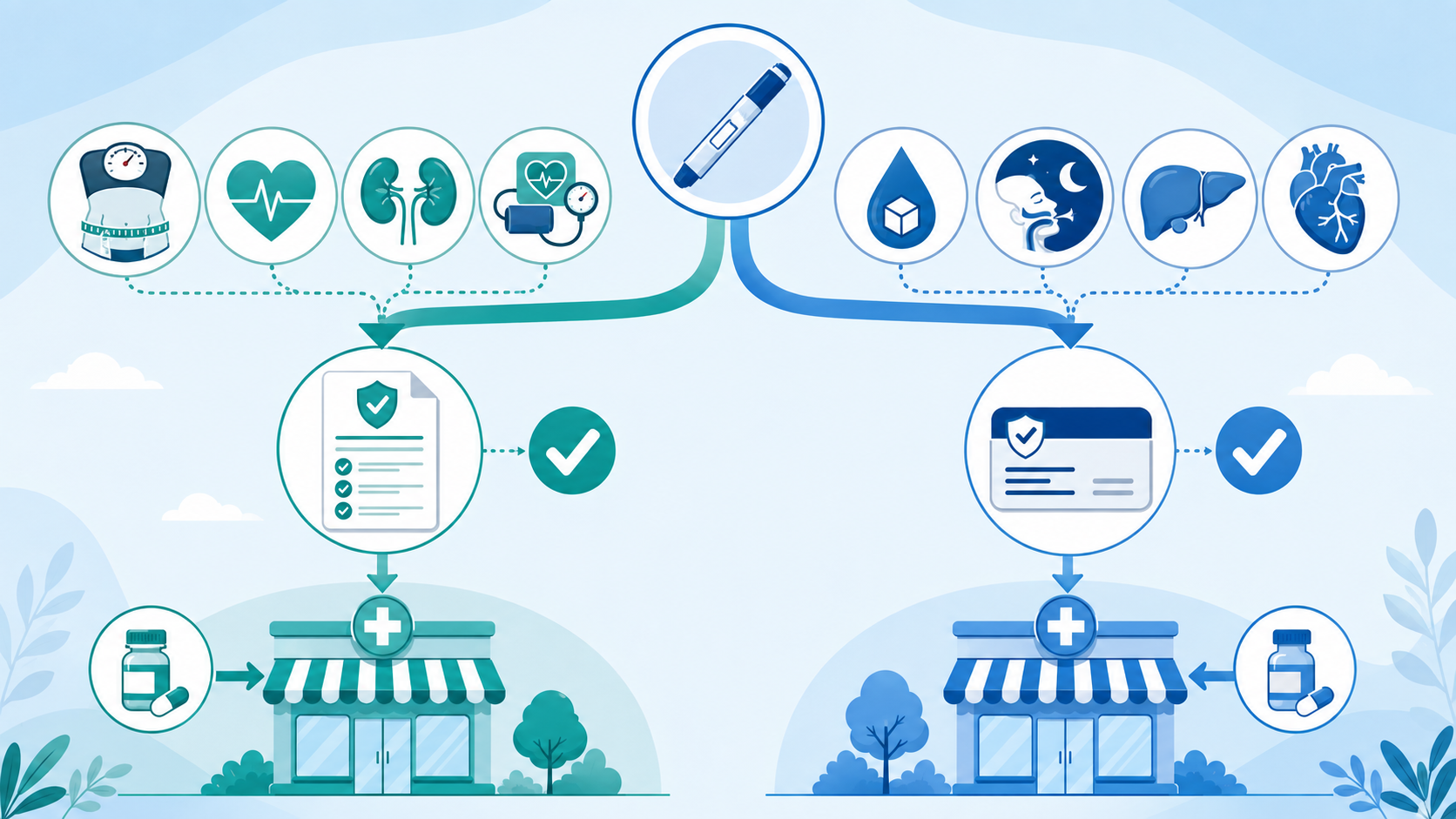
    Decision pathway for Medicare GLP-1 Bridge versus regular Part D coverage
    The correct Medicare pathway depends on the drug’s covered indication and the beneficiary’s clinical criteria.

    Who qualifies for Medicare Wegovy coverage through the GLP-1 Bridge?

    A beneficiary must have an eligible form of Medicare drug coverage, be at least 18 years old, receive the drug for weight reduction together with ongoing nutrition and physical-activity support, and meet one of the CMS clinical thresholds at the time GLP-1 therapy began.

    BMI at treatment initiation Additional clinical requirement
    35 or higher No additional condition is listed in the Bridge’s BMI pathway
    30 or higher At least one: heart failure with preserved ejection fraction; uncontrolled hypertension despite two antihypertensive medicines; or chronic kidney disease stage 3a or higher
    27 or higher At least one: prediabetes; previous heart attack; previous stroke; or symptomatic peripheral artery disease

    CMS defines uncontrolled hypertension for this program as systolic pressure above 140 mm Hg or diastolic pressure above 90 mm Hg despite concurrent treatment with two blood-pressure medicines. Do not assume that a current lower BMI automatically disqualifies someone who started therapy earlier: CMS says eligibility is evaluated using the criteria at the time GLP-1 therapy was initiated. The prescriber still needs accurate records supporting that history.

    Eligible plan types

    Examples include standalone Part D prescription drug plans, coordinated-care Medicare Advantage plans with drug coverage, Special Needs Plans, employer or union group waiver plans, and the LI NET program. Some special plan types are excluded unless the person is also enrolled in an eligible standalone prescription drug plan. If your plan type is unclear, call 1-800-MEDICARE before asking the medical office to start paperwork.

    Who should use regular Part D instead?

    The Bridge is specifically for weight management. CMS states that a beneficiary who has type 2 diabetes, moderate-to-severe sleep apnea, or qualifying MASH should obtain the GLP-1 through the Part D plan for that condition, even if the plan does not currently list the requested drug on its formulary. That is where the Part D coverage-determination and formulary-exception process becomes important.

    A second exclusion can surprise people: if Medicare data show that a Part D plan already paid for a GLP-1 fill during 2026, the beneficiary is generally not eligible for the Bridge in 2026 and should continue through the Part D plan. Cash-paid use outside Medicare is a different situation; verify the facts with 1-800-MEDICARE rather than guessing.

    Which drugs and formulations qualify for Medicare Wegovy coverage?

    As of September 5, 2026, the Medicare beneficiary page lists Foundayo tablets, Wegovy injections and tablets, and Zepbound KwikPen. The current FDA Wegovy prescribing information describes the approved formulations, indications, contraindications, and safety warnings. The FDA Zepbound prescribing information does the same for tirzepatide. The Bridge specifically excludes Zepbound single-dose vials and single-dose pens. CMS can update the product and National Drug Code list, so a familiar brand name is not enough: ask the pharmacy to confirm that the prescribed package and formulation match the current Bridge list.

    For a broader comparison of current cash-pay options, see our Wegovy vs. Zepbound self-pay guide. If you have employer insurance or an ACA plan rather than Medicare, use our general weight-loss medication coverage guide.

    What does the $50 copay include—and not include?

    Under Medicare Wegovy coverage through the Bridge, an eligible beneficiary pays $50 for each covered monthly supply. CMS pharmacy guidance says only 28-day or 30-day fills are covered, not longer fills. The amount remains $50 regardless of the beneficiary’s income or current Part D benefit phase.

    Three limits are easy to miss:

    • The $50 does not count toward the Part D deductible.
    • It does not count toward the Part D annual out-of-pocket limit, also called true out-of-pocket or TrOOP spending.
    • Extra Help does not reduce the Bridge copay, and coupons or discount programs cannot be combined with a Bridge claim.

    The $50 is the medicine copay, not an all-inclusive treatment price. Office visits, nutrition services, laboratory testing, or management of side effects can have separate coverage and cost-sharing rules.

    How to start a Medicare Wegovy coverage request

    The order is unusual. A prescriber should not submit the Bridge prior authorization before the pharmacy sends the initial claim. CMS provider instructions warn that an early authorization request can return a “patient not found” error.

    1. Confirm the coverage route. Ask whether the prescription is for weight management or a Part D-coverable medical indication.
    2. Confirm eligible drug coverage. Verify that you have an eligible Part D or Medicare Advantage drug plan.
    3. Ask the prescriber to document the starting criteria. The chart should support BMI at GLP-1 initiation, any qualifying condition, the weight-management purpose, and ongoing lifestyle modification.
    4. Send the prescription to the pharmacy. The pharmacy submits the claim to the Bridge processor and receives the prior-authorization trigger.
    5. Wait for the authorization request. CMS says the pharmacy typically sends it to the prescriber electronically or by fax within 24 to 72 hours. If nothing arrives after 72 hours, the prescriber can use the CMS fax form.
    6. The prescriber completes the authorization. Approval or denial is sent to the prescriber and mailed to the beneficiary, generally within 72 hours after submission.
    7. The pharmacy dispenses the approved product. The beneficiary pays $50 for the covered monthly fill.

    CMS says a Bridge authorization generally remains valid for refills and dose changes through December 31, 2027, unless the beneficiary switches to a different GLP-1 drug. A switch requires a new authorization.

    Prior-authorization checklist for the medical visit

    Bring or verify the following before the prescription is sent:

    • Medicare card and current drug-plan card
    • Current medication list and the name of any GLP-1 used in 2026
    • Documented weight, height, and BMI when GLP-1 treatment began
    • Records supporting prediabetes, previous heart attack or stroke, symptomatic peripheral artery disease, heart failure with preserved ejection fraction, resistant hypertension, or chronic kidney disease stage 3a or higher
    • A brief charted plan for structured nutrition and physical activity
    • The exact requested drug and formulation
    • The preferred pharmacy’s phone and fax information

    Do not ask a clinician to select a diagnosis merely to fit the program. The prescriber attests under penalty of perjury that the information is accurate, and CMS may compare the request with Medicare data.

    What to do if Medicare Wegovy coverage is denied

    If the Bridge prior authorization is denied

    Read the denial reason first. CMS says the Bridge has no formal appeal process. However, the prescriber may resubmit the authorization if information was incorrect, incomplete, updated, or newly available. A useful response is specific: correct the BMI date, attach the qualifying diagnosis, confirm the weight-management indication, or document the lifestyle program—whichever item caused the denial.

    If the Part D plan denies a coverable indication

    This is a different process. A beneficiary, prescriber, or representative may request a coverage determination and, when appropriate, a formulary exception. The prescriber must explain why covered alternatives would be less effective or could cause adverse effects. If the decision is unfavorable, the notice should explain how to request redetermination.

    Do not let the two denial systems blur together: a Bridge denial can be corrected and resubmitted but has no Bridge appeal; a regular Part D denial carries the plan’s determination, exception, and appeal rights.

    A practical phone script

    When calling the plan, pharmacy, or medical office, use a short question that identifies the route:

    “My prescription is for [weight management / a specific covered condition]. Should this claim go through the Medicare GLP-1 Bridge or my Part D plan? Has the pharmacy submitted the initial claim, and is the prior authorization waiting with my prescriber?”

    If the status is unclear, ask for the rejection or authorization reason verbatim, the date it was sent, the destination fax or electronic portal, and the next responsible party. Write down names, dates, and reference numbers.

    Medicare Wegovy coverage: frequently asked questions

    Does Medicare automatically cover Wegovy for weight loss?

    No. A beneficiary must have eligible drug coverage, meet the Bridge’s clinical criteria, receive Wegovy for weight management with ongoing lifestyle modification, and complete prior authorization. A different indication may need to go through Part D.

    Does Medicare cover Zepbound for sleep apnea?

    A prescription for moderate-to-severe obstructive sleep apnea in an adult with obesity should be evaluated through the Part D plan, not the weight-management Bridge. Formulary status and utilization-management rules still matter, and an exception request may be necessary.

    Will Extra Help reduce the $50 Bridge copay?

    No. CMS says the low-income subsidy does not apply to the Bridge copay because the demonstration operates outside the Part D benefit.

    Can I use a manufacturer coupon with the Bridge?

    No. CMS says coupons and discount programs cannot be applied to Bridge claims.

    Do I need a new authorization after a dose increase?

    Not ordinarily. Medicare.gov says the authorization remains valid for refills and dose changes through December 31, 2027, unless you switch GLP-1 drugs.

    Where can I check my eligibility or authorization status?

    Use the eligibility questions on Medicare.gov or call 1-800-MEDICARE (1-800-633-4227). TTY users can call 1-877-486-2048.

    Bottom line

    Medicare Wegovy coverage in 2026 is real, but it is not one universal benefit. The fastest path begins by matching the prescription’s purpose to the correct system: Bridge for eligible weight-management use, regular Part D for an already coverable medical indication. Then follow the Bridge sequence precisely—prescription to pharmacy, initial claim, prior-authorization request, prescriber response—and keep documentation of BMI at treatment initiation and qualifying conditions.

    Sources


    Written and edited by: Denny Jaeyong Choi (JD), INSEAD MBA.
    Last updated: September 7, 2026

    Medical and insurance disclaimer: This article provides general educational information and does not replace individualized medical advice, a coverage determination, or the terms of a Medicare plan. Drug indications, program rules, formularies, and costs can change. Confirm current eligibility and coverage with Medicare, your plan, your prescriber, and your pharmacy before making treatment or financial decisions.

  • Wegovy vs Zepbound Cost Without Insurance: 2026 Self-Pay Guide

    Wegovy vs Zepbound Cost Without Insurance: 2026 Self-Pay Guide

    Quick answer: Wegovy vs Zepbound cost without insurance depends on the dose and program rules. For people paying cash in the United States, the official September 2026 self-pay price for a standard-dose Wegovy pen is generally $349 per 28-day fill after a limited new-patient offer. Zepbound starts at $299 for 2.5 mg, costs $399 for 5 mg, and can cost $449 for higher doses when refill conditions are met. The cheaper option depends on your prescribed maintenance dose, refill timing, device, and eligibility—not just the advertised starting price.

    This comparison focuses on official manufacturer self-pay channels for the injectable products, not unpredictable retail cash prices or compounded alternatives. Prices and program rules can change. Confirm them before every fill, and do not choose or change a medicine or dose based on price alone.

    The practical takeaway

    • Lowest advertised starting fill: Wegovy $199 for eligible new patients versus Zepbound $299.
    • Common standard ongoing self-pay price: Wegovy $349 per 28 days.
    • Zepbound maintenance price: $399 at 5 mg or $449 at 7.5–15 mg when the 45-day refill condition is met.
    • Budgeting trap: “Monthly” usually means 28 days, so continuous use can require 13 fills over 364 days—not 12.

    Wegovy vs Zepbound cost: official self-pay prices

    The table below uses the manufacturers’ U.S. self-pay pages as of September 4, 2026. A “month” means a 28-day supply. It does not include medical visits, laboratory testing, needles, syringes, taxes, or other fees.

    Product and doseOfficial self-pay priceImportant condition
    Wegovy pen, 0.25 or 0.5 mg$199 per fill for the first two fillsLimited offer for eligible new patients through December 31, 2026
    Wegovy pen, 0.25–2.4 mg$349 per 28-day fillApplies after the introductory fills and to standard-dose strengths under current terms
    Wegovy HD pen, 7.2 mg$399 per 28-day fillDifferent formulation and price; use only if prescribed
    Zepbound, 2.5 mg$299 per 28-day fillStarting dose; FDA labeling says it is not a maintenance dose
    Zepbound, 5 mg$399 per 28-day fillCurrent official self-pay price
    Zepbound, 7.5–15 mg$449 per 28-day fillRefill within 45 days to maintain the Self-Pay Journey Program price
    Current program prices, not guaranteed retail prices. Eligibility, prescription, approved-use, device, refill, and program terms apply.

    Novo Nordisk’s official Wegovy cost page states that new patients can pay $199 for each of the first two 0.25 mg or 0.5 mg fills through December 31, 2026, then $349 for standard pen strengths. Eli Lilly’s LillyDirect Zepbound page lists $299 for 2.5 mg, $399 for 5 mg, and $449 for higher doses under the current refill program.

    Why Wegovy vs Zepbound cost is more than the starting price

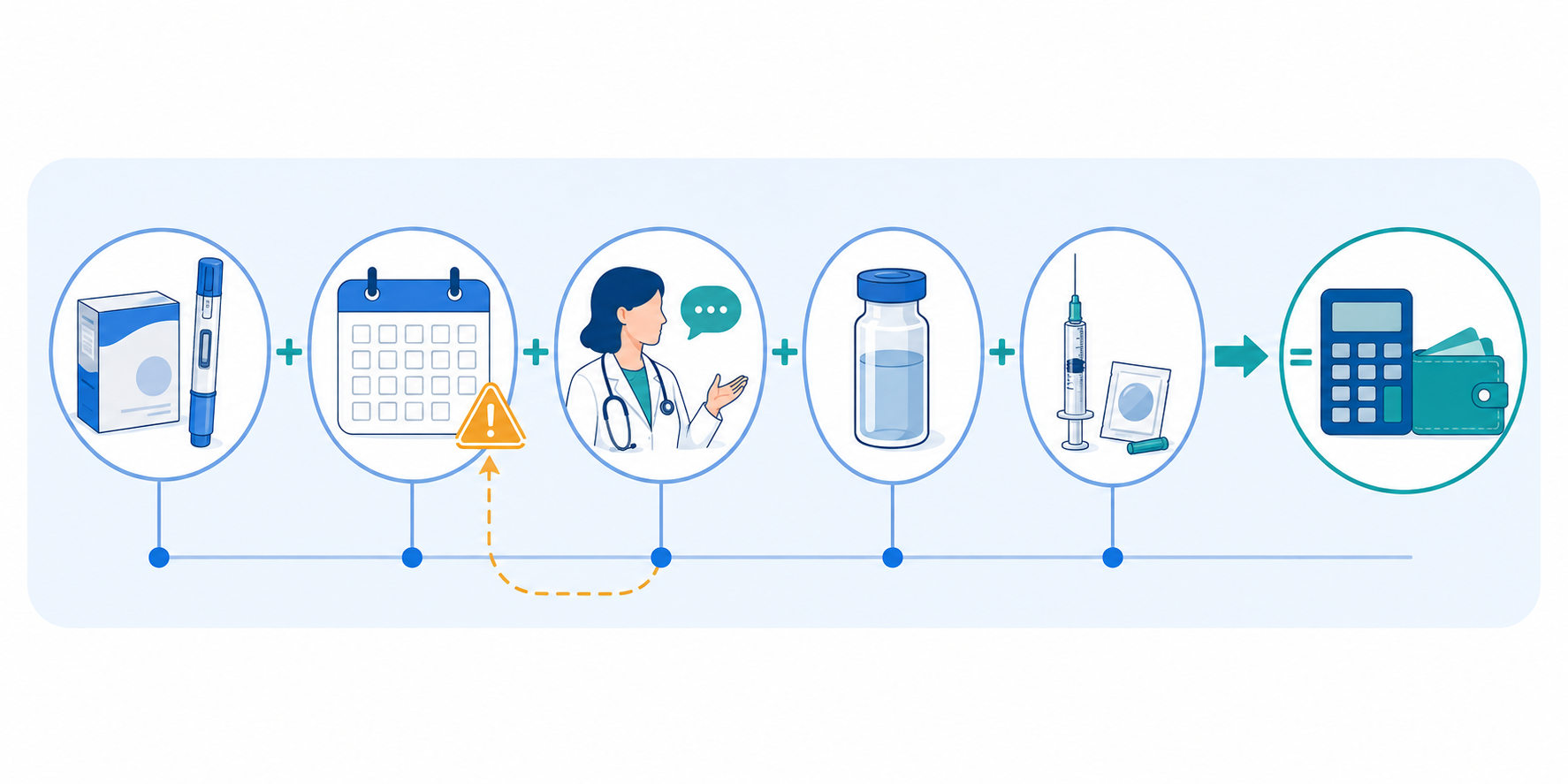
    The headline price usually describes one dose, one fill, and one set of eligibility rules. It does not tell you what you will spend after titration or across a full year. Before comparing Wegovy vs Zepbound cost, identify four details:

    1. Your prescribed product and device. Zepbound is available through different delivery formats, including a multi-dose KwikPen and single-dose vials. Supplies and handling differ.
    2. Your maintenance dose. Zepbound’s ongoing self-pay price is different at 5 mg than at higher doses. Wegovy also has a separately priced HD formulation.
    3. Your refill cadence. Both programs define a month as 28 days. Zepbound’s $449 higher-dose purchase offer also requires timely refills.
    4. Whether you remain eligible. Manufacturer programs may be changed or canceled, and their rules are not insurance coverage.

    How Wegovy vs Zepbound cost changes over 13 fills

    A 28-day supply repeated continuously creates 13 prescription cycles in 364 days. Multiplying a “monthly” price by 12 therefore understates drug spending for someone who fills every four weeks. The scenarios below are illustrations, not dosing recommendations.

    Illustrative cash-pay pattern12 fills (336 days)13 fills (364 days)
    Wegovy standard pen: two $199 introductory fills, then $349$3,888$4,237
    Zepbound: one $299 fill, then remaining fills at $399$4,688$5,087
    Zepbound: one $299 fill, one $399 fill, then higher-dose fills at $449$5,188$5,637
    Drug-only arithmetic using current program prices. Your prescribed dose progression may differ, and treatment may be interrupted or discontinued.

    This is the most important lesson from the price comparison: the difference between two options may be hundreds or more than a thousand dollars over a year, but only after the actual maintenance dose and refill schedule are known.

    The Zepbound 45-day refill rule

    For 7.5, 10, 12.5, and 15 mg Zepbound, the Self-Pay Journey Program currently offers $449 per 28-day fill. To continue at that price, Lilly says the refill purchase must be completed within 45 days of the previous delivery or receipt date. Missing the window can trigger the regular self-pay price.

    Zepbound doseProgram priceRegular price if higher-dose offer does not apply
    7.5 mg$449$499
    10 mg$449$699
    12.5 mg$449$699
    15 mg$449$699

    Set a refill reminder based on the delivery or pickup date, not merely the date the prescription was written. If treatment is intentionally paused for a medical reason, contact the program before assuming the same price will resume automatically.

    Total GLP-1 self-pay cost includes medication, 28-day refills, visits, lab tests, and injection supplies
    The medication price is only one part of a realistic self-pay budget.

    What Wegovy vs Zepbound cost may not include

    • Initial and follow-up visits: Ask whether a telehealth membership or recurring clinician fee is required.
    • Laboratory tests: The clinician may order testing based on your history, symptoms, and other medications. Ask which tests are required and what they cost before collection.
    • Injection supplies: Lilly notes that Zepbound KwikPen users need pen needles, while vial users need a new needle and syringe. These may be purchased separately.
    • Shipping or pickup fees: Official channels currently advertise free delivery or designated pickup options, but verify your location and checkout total.
    • Taxes and fees: Program materials state that additional taxes or fees may apply.
    • Care for side effects or complications: Medical evaluation and treatment are separate from the drug price.

    Paying the Wegovy vs Zepbound cost: cash or insurance

    Self-pay can be simpler when a plan excludes anti-obesity medication or requires a long authorization process. However, paying outside insurance may not count toward your deductible or annual out-of-pocket limit. NovoCare explicitly warns about this on its Wegovy pricing page.

    Before choosing cash pay, compare it with the full insurance pathway. Our guide, Does Insurance Cover Weight Loss Medication in 2026?, explains formularies, prior authorization, Medicare, Medicaid, and appeals. If insurance covers the medicine, a commercial-insurance savings card may reduce the copay—but eligibility and maximum-savings rules apply.

    A five-question script before you pay

    “Please confirm the exact product, dose, device, and quantity. Is this a 28-day supply? What will I pay today, and what will the next three fills cost if my dose changes? Are clinician visits, labs, needles, syringes, shipping, taxes, or membership fees separate? What deadline must I meet to keep the program price?”

    Request the answers in writing or save a screenshot of the checkout terms. Manufacturer prices can change faster than an article can be updated.

    Do not treat compounded GLP-1 products as identical substitutes

    Some advertisements compare a low compounded-product price with a branded medicine’s list price. That is not an apples-to-apples comparison. The FDA states that compounded drugs are not reviewed for safety, effectiveness, or quality before marketing in the same way as FDA-approved products. The agency has also reported dosing errors and concerns about products marketed as alternatives to approved semaglutide or tirzepatide.

    Read the FDA’s current GLP-1 safety guidance. If an approved product cannot meet a specific medical need, discuss legally appropriate compounding with a licensed clinician and state-licensed pharmacy; do not make the decision from price alone.

    Frequently asked questions

    Which is cheaper without insurance: Wegovy or Zepbound?

    Under current official self-pay programs, standard-dose Wegovy is usually cheaper after the introductory period at $349 per 28 days. Zepbound is $399 at 5 mg and $449 at higher doses when program refill conditions are met. The medically appropriate treatment and dose must be decided separately.

    Is the $199 Wegovy price permanent?

    No. As of September 4, 2026, it is a limited introductory price for the first two eligible new-patient fills of 0.25 mg or 0.5 mg, available through December 31, 2026. Current terms then price standard pen strengths at $349 per fill.

    Why can a year require 13 “monthly” payments?

    Because the programs define one month as 28 days. Thirteen 28-day supplies cover 364 days. Actual spending depends on your fill dates and whether treatment continues without interruption.

    Does self-pay require prior authorization?

    The Zepbound self-pay program states that prior authorization is not required, but a valid prescription for an approved use and other conditions apply. This is different from submitting the medication through an insurance plan.

    Does cash spending count toward my insurance deductible?

    Often it does not when the purchase is processed outside insurance. Confirm with your plan before paying. Keep receipts in case your plan has a reimbursement or manual-claim process, but do not assume reimbursement will be approved.

    Bottom line

    The most useful Wegovy vs Zepbound cost comparison is based on the next 13 fills, not the first advertised price. Write down the prescribed dose, device, 28-day price, refill deadline, likely maintenance price, and every separate clinical or supply fee. Then compare the full cash-pay budget with your insurance option before committing.


    Sources and further reading

    Written and edited by: Denny Jaeyong Choi (JD), INSEAD MBA
    Last updated: September 7, 2026

    Medical information notice: This article provides general educational information and does not replace individualized medical advice, diagnosis, or treatment. Prices, eligibility rules, and programs can change. Verify current terms with the manufacturer, pharmacy, insurer, and prescribing clinician.

  • Does Insurance Cover Weight Loss Medication in 2026? A Practical GLP-1 Guide

    Does Insurance Cover Weight Loss Medication in 2026? A Practical GLP-1 Guide

    Quick answer: Weight loss medication coverage varies by plan. Insurance sometimes covers prescription treatment, but payment depends on the exact drug and formulation, the diagnosis being treated, and whether you complete requirements such as prior authorization. A prescription by itself does not guarantee payment.

    To understand weight loss medication coverage, the fastest way to get a reliable answer is not to ask, “Do you cover GLP-1 drugs?” Ask whether your plan covers the exact product for your specific FDA-approved indication, then request the written coverage policy and prior-authorization form. This guide explains how to do that, what evidence your clinician may need, and how to respond if the claim is denied.

    The answer depends on four separate questions

    1. Does your plan include anti-obesity medications? Some plans exclude the entire benefit category, even when they cover other prescription drugs.
    2. Is the exact drug on the formulary? Coverage may differ by brand, dose, device, and formulation.
    3. Is it being prescribed for a covered indication? The same active ingredient can be sold under different brand names with different FDA-approved uses.
    4. Have you met the utilization rules? Prior authorization, step therapy, quantity limits, network-pharmacy rules, and renewal criteria can all affect payment.

    Why the name on the prescription matters

    “Semaglutide” or “tirzepatide” is not enough information for an insurance check. Insurers adjudicate the specific product and indication. For example, the FDA labels Wegovy for chronic weight management and certain additional indications, while the Ozempic label is centered on type 2 diabetes and related cardiovascular and kidney-risk reduction. Similarly, Zepbound is approved for chronic weight management, whereas Mounjaro is labeled for type 2 diabetes.

    ProductActive ingredientSelected FDA-approved use relevant to coveragePractical insurance implication
    WegovySemaglutideChronic weight management; cardiovascular-risk reduction in qualifying adults; additional labeled usesMay be evaluated under an obesity benefit or another covered indication, depending on the plan
    ZepboundTirzepatideChronic weight management; moderate-to-severe obstructive sleep apnea in adults with obesityAsk which indication and clinical criteria the plan uses
    OzempicSemaglutideType 2 diabetes and related labeled risk-reduction usesUse solely for weight loss may be treated as off-label and denied
    MounjaroTirzepatideType 2 diabetesUse solely for weight loss may be treated as off-label and denied
    FDA labels evolve. Confirm the current label and your plan policy rather than assuming that drugs with the same ingredient are interchangeable.

    Zepbound also has an FDA-approved indication for moderate-to-severe obstructive sleep apnea in adults with obesity. That does not guarantee coverage, but it can change which policy and documentation apply. Your clinician should identify the medically appropriate, labeled indication rather than trying to “game” the claim.

    Weight loss medication coverage by insurance type

    Employer-sponsored and other commercial plans

    Two people with the same insurance company can have different benefits because employers often choose different prescription designs. One plan may cover anti-obesity drugs with prior authorization; another may exclude them. Start with the Summary Plan Description or pharmacy benefit materials, then call the number on the prescription card. For employer plans, the U.S. Department of Labor recommends consulting the plan documents and following the plan’s claims and appeal procedures.

    Marketplace and individual plans

    Review the plan’s drug formulary and Summary of Benefits and Coverage. HealthCare.gov advises members to check whether a medicine is covered, what it costs, and whether an exception process is available. Marketplace plans must provide a way to appeal many adverse benefit decisions, but that process cannot necessarily override a clearly written benefit exclusion.

    Medicaid

    Medicaid prescription coverage is state-specific. Check your state Medicaid agency’s current preferred drug list and prior-authorization criteria. Do not assume that a policy in a neighboring state applies to you. The federal State Prescription Drug Resources page is a useful starting point.

    Medicare weight loss medication coverage in 2026

    As of September 4, 2026: the CMS Medicare GLP-1 Bridge is a temporary nationwide demonstration running from July 1, 2026 through December 31, 2027 for eligible Medicare Part D beneficiaries. CMS states that eligible participants pay a $50 monthly copay and must obtain prior authorization.

    Current Bridge products listed by CMS include certain formulations of Foundayo, Wegovy, and Zepbound; the list may change. Clinical eligibility includes adults with obesity or overweight who meet specific BMI and comorbidity criteria. People using a GLP-1 for another coverable Part D indication—such as type 2 diabetes, qualifying obstructive sleep apnea, or certain liver-disease indications—may need to seek coverage through their Part D plan rather than the Bridge.

    Check the current Medicare consumer guidance and CMS Bridge criteria before acting. These details are time-sensitive.

    How to check weight loss medication coverage: six steps

    1. Collect the exact prescription details

    • Brand name and active ingredient
    • Formulation and strength
    • Diagnosis or FDA-approved indication being treated
    • Prescriber’s name and contact information

    2. Search the current formulary

    Use the formulary for the current plan year—not an old PDF found through a general web search. Search for the brand name and review the notes for tier, prior authorization, step therapy, quantity limits, age limits, and specialty-pharmacy requirements. If the drug is absent, look for the plan’s formulary-exception process.

    3. Call the pharmacy-benefit number

    “I am checking coverage for [exact drug, formulation, and strength] for [diagnosis/indication]. Is anti-obesity medication included or excluded under my plan? Is this product on the current formulary? What tier is it, and does it require prior authorization, step therapy, quantity limits, or a specific pharmacy? Please send me the written policy and prior-authorization form, and give me a reference number for this call.”

    Also ask for your expected cost after the deductible, whether coinsurance is based on the negotiated price, and what renewal criteria apply. Record the date, representative’s name, and call reference number.

    4. Read the clinical criteria before the appointment

    Requirements vary, but policies may ask for a documented BMI, qualifying weight-related conditions, previous treatment attempts, participation in lifestyle modification, or reasons that preferred alternatives are inappropriate. These are plan rules, not universal medical standards. For context on cardiometabolic risk documentation, see our guide to the five metabolic syndrome criteria.

    5. Give your clinician the actual form

    Do not rely on a generic note saying “medically necessary.” A strong submission answers each question in the plan’s policy and may include:

    • Baseline and current weight, height, and BMI
    • Relevant diagnoses and objective clinical history
    • The FDA-approved indication being treated
    • Previous therapies, outcomes, adverse effects, or contraindications when the policy asks for them
    • Why a formulary alternative is expected to be less effective or unsafe, when applicable
    • A monitoring and follow-up plan

    6. Confirm approval before filling the prescription

    Ask for the authorization number, start and end dates, approved dose or quantity, required pharmacy, and renewal criteria. Approval does not always mean a low copay; verify your actual out-of-pocket amount before the pharmacy dispenses the medicine.

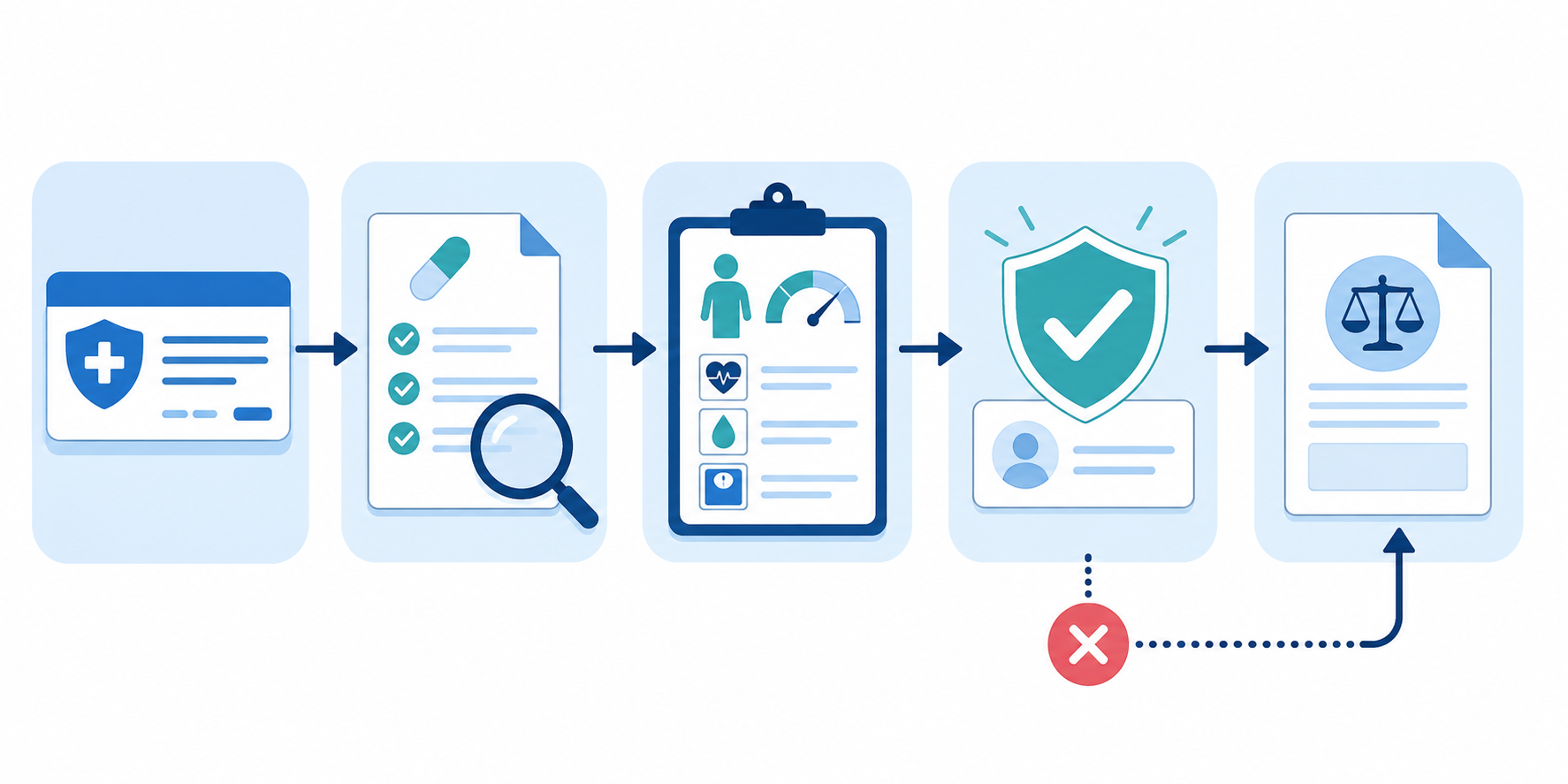
    Steps for checking coverage, prior authorization, and appealing a weight-loss medication denial
    A practical path from formulary check to prior authorization and appeal.

    If weight loss medication coverage is denied

    Denial reasonWhat it usually meansUseful next step
    Benefit exclusionThe plan excludes anti-obesity drugs as a categoryConfirm the exact exclusion in writing. An appeal may not overcome plan design; ask an employer benefits team about future coverage options.
    Non-formulary drugThe product is not on the covered listAsk about preferred alternatives and whether a formulary exception is available.
    Incomplete prior authorizationRequired fields or records were missingRequest the denial details and resubmit a complete packet promptly.
    Step therapy not completedThe plan requires a preferred treatment firstDocument the trial, failure, adverse effect, or clinical reason the required step is inappropriate.
    Indication not coveredThe diagnosis or use does not meet the policyVerify coding and the labeled indication; discuss a covered, medically appropriate alternative with the clinician.
    Renewal criteria not metThe plan requires a specified response or follow-upSubmit objective progress data, or discuss whether continuing treatment is clinically appropriate.

    How to appeal a denial

    1. Get the denial in writing. You need the reason, policy language, clinical criteria, appeal deadline, and submission route. Do not rely only on what the pharmacy screen says.

    2. Match the response to the reason. Ask the prescriber to address the specific missing criterion and attach relevant records. For a non-formulary request, explain why covered alternatives would be less effective, have caused adverse effects, or are contraindicated when that is medically accurate.

    3. File on time and keep a complete copy. HealthCare.gov states that an internal appeal generally must be filed within 180 days of receiving a denial. Include the denial or Explanation of Benefits, the appeal request, supporting clinician letters, records, and a log of calls. Your plan documents control the actual deadline.

    4. Request external review if eligible. If an internal appeal remains denied, an independent external review may be available. HealthCare.gov says the request is generally due within four months of the final denial; urgent cases may qualify for an expedited process.

    Medicare Part D exception: CMS allows requests for a non-formulary drug or for waiver of certain utilization rules. A prescriber’s supporting statement is important. CMS lists a standard decision timeframe of 72 hours, or 24 hours for an expedited request, after the supporting statement is received.

    Medicare GLP-1 Bridge exception: CMS says there is no formal appeal process for a Bridge prior-authorization denial. The provider may resubmit corrected or additional information, so obtain the precise reason and respond to it quickly.

    What to do if the drug is not covered

    • Ask about covered alternatives. The best alternative depends on your medical history, other medications, contraindications, and treatment goals.
    • Compare total cost, not only the coupon headline. Check the in-network pharmacy price, deductible, coinsurance, cash price, follow-up visits, and supplies.
    • Verify manufacturer program rules directly. Eligibility and terms can change, and government-insurance restrictions often apply.
    • Revisit employer benefits during enrollment. If the issue is a categorical exclusion, the benefits team—not the pharmacy—may be the relevant decision-maker.
    • Be cautious with compounded products. The FDA warns that unapproved compounded semaglutide and tirzepatide are not reviewed for safety, effectiveness, or quality in the same way as approved drugs. Use a state-licensed pharmacy and consider compounding only when a clinician determines that an approved product cannot meet the patient’s medical need.

    Frequently asked questions

    Does a prescription guarantee insurance coverage?

    No. A prescription indicates that a clinician ordered the drug; it does not establish that the plan includes the benefit, lists the product, or considers the patient eligible under its policy.

    Does insurance cover Ozempic for weight loss?

    Many plans evaluate Ozempic under its FDA-approved type 2 diabetes indications. Use solely for weight loss may be considered off-label and denied. Coverage is plan-specific, so check the exact formulary and policy. Wegovy contains semaglutide but has different labeled indications; it is not automatically covered either.

    Can my employer add weight-loss medication coverage?

    Potentially. For self-funded or employer-selected benefit designs, the employer or benefits consultant may influence which categories are included. Ask the benefits team whether the exclusion is an employer plan-design decision and whether it will be reviewed for the next plan year.

    Does Medicare cover weight-loss medication in 2026?

    Some eligible Part D beneficiaries can access selected products through the temporary Medicare GLP-1 Bridge beginning July 1, 2026, subject to prior authorization and clinical criteria. Other FDA-approved indications may be covered through the regular Part D benefit. Verify current CMS rules because the demonstration and product list are time-limited.

    How long does prior authorization take?

    It varies by plan and by whether the request is standard or urgent. Ask the plan when its review clock begins and what makes a submission complete. Do not confuse commercial-plan timelines with Medicare Part D exception timelines.

    Bottom line

    Weight loss medication coverage becomes easier to verify when the question is specific. The most useful question is not “Does insurance cover weight-loss drugs?” It is: “Does my current plan cover this exact product, for this diagnosis, under these clinical criteria, at this pharmacy, and at what out-of-pocket cost?” Get the answer in writing, give the correct policy to the prescriber, and treat a denial as a document with a specific reason—not as the end of the process.


    Sources and further reading

    Written and edited by: Denny Jaeyong Choi (JD), INSEAD MBA
    Last updated: September 7, 2026

    Medical information notice: This article provides general educational information and does not replace individualized medical advice, diagnosis, or treatment. Coverage rules change and your plan documents control. Discuss treatment decisions with a qualified clinician and verify benefits directly with your insurer.